
Options trading offers powerful tools for investors at every level — but complexity can work against you when you’re starting out. The best beginner strategies share three characteristics: defined risk, clear profit potential, and simple execution. Master these foundational strategies first and everything else in options trading becomes easier to understand.
This guide covers the three best options strategies for beginners, how each one works, when to use it, and how to choose the right one based on your goals.
New to options trading?
Start here: Options Trading for Beginners
Why Strategy Selection Matters for Beginners
Most beginner losses in options trading don’t come from choosing the wrong strategy — they come from using a strategy without fully understanding it. Time decay catches buyers off guard. Assignment surprises sellers. Position sizes get too large too quickly.
Starting with the right strategy — one that matches your goals, your account size, and your current knowledge level — is more important than finding the “best” strategy in the abstract. There is no universally best strategy. There’s only the best strategy for your situation.
For a complete introduction to how options work before diving into strategies see our guide on Options Trading for Beginners.
The 3 Best Options Strategies for Beginners
Strategy 1: Buying Call Options
Best for: Traders who expect a specific stock to rise and want leveraged upside with defined risk.
Difficulty: Beginner Capital required: Premium only — as low as $100-$500 per contract Max loss: Premium paid Max profit: Unlimited
How it works: A call option gives you the right to buy 100 shares of a stock at the strike price before expiration. You pay a premium upfront — that’s your maximum loss, no matter what the stock does. If the stock rises above your breakeven (strike price plus premium paid), the option gains value and you profit.
For a complete explanation see our guide on How Call Options Work.
Example:
- Stock: Nvidia (NVDA) at $130
- You buy: 1 NVDA $135 call, 30 days to expiration
- Premium: $3.00 per share
- Total cost: $300
- Breakeven at expiration: $138
If NVDA rises to $150 before expiration:
- Your call may be worth approximately $15
- Value: $15 × 100 = $1,500
- Profit: $1,200 on a $300 investment — a 400% return
If NVDA stays flat or falls:
- The option expires worthless
- Maximum loss: $300
What makes it beginner-friendly: Your risk is completely defined before you enter. No matter how far the stock falls, you cannot lose more than the premium paid. This makes it one of the most straightforward ways to take a bullish position with a clear worst-case scenario.
The key risk beginners miss: Time decay. Even if the stock moves in your direction, the option loses extrinsic value every day. The stock needs to move enough, fast enough, to overcome daily Theta decay. See our guide on What Is Theta in Options.
Best practices for beginners buying calls:
- Target liquid stocks with tight bid-ask spreads — SPY, AAPL, NVDA, MSFT
- Use 30-60 day expirations — weekly options decay too fast for beginners
- Target slightly out-of-the-money or at-the-money strikes
- Never risk more than 2-5% of your account on a single call
- Set a mental exit plan before entering — know at what profit you’ll close
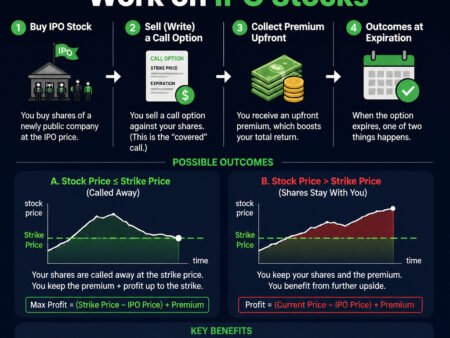
Strategy 2: The Covered Call
Best for: Investors who already own stocks and want to generate consistent monthly income.
Difficulty: Beginner Capital required: 100 shares of the underlying stock Max loss: Stock decline below purchase price (reduced by premium) Max profit: Premium collected plus stock gain up to strike price
How it works: You own 100 shares of a stock and sell a call option against those shares, collecting premium immediately. If the stock stays below your strike price at expiration, the option expires worthless and you keep the premium and your shares. Repeat next month. If the stock rises above your strike, your shares are sold at that price — but you still keep the premium and any gain up to the strike.
For a complete guide including strike selection, the 30-45 DTE window, and rolling see our Covered Call Strategy guide.
Example:
- Stock: Apple (AAPL) at $180 — you own 100 shares
- You sell: 1 AAPL $190 call, 30 days to expiration
- Premium: $2.00 per share
- Premium collected: $200
If AAPL stays below $190 at expiration:
- Option expires worthless
- You keep $200 and your shares
- Annualized yield: approximately 13% on the position
If AAPL rises above $190 at expiration:
- Shares called away at $190
- You keep $200 premium plus $1,000 gain ($10 per share × 100)
- Total profit: $1,200
If AAPL falls to $160:
- Option expires worthless — you keep $200
- Shares now worth $16,000 instead of $18,000
- Premium reduces your effective loss
What makes it beginner-friendly: The covered call is considered one of the safest options strategies because you already own the shares. You’re simply adding an income layer on top of a stock position you’d hold anyway.
The key risk beginners miss: Capped upside. If you sell a $190 covered call and Apple rises to $220, your shares get called away at $190 — you miss the gain above the strike. Only sell covered calls at strike prices you’d genuinely be happy selling your shares at.
Strike selection guidance: Most income traders target the 20-35 Delta range — strikes with approximately 65-80% probability of expiring worthless. This balances meaningful premium collection with acceptable assignment risk. See our guide on How to Pick the Right Strike Price.
Strategy 3: The Cash-Secured Put
Best for: Investors who want to acquire a stock at a lower price while getting paid to wait — or generate income from cash reserves.
Difficulty: Beginner Capital required: Enough cash to buy 100 shares at the strike price Max loss: Stock falling to zero minus premium collected Max profit: Premium collected
How it works: You sell a put option on a stock you’d be willing to own, keeping enough cash in your account to buy the shares if assigned. If the stock stays above your strike price at expiration, the put expires worthless and you keep the premium. If the stock falls below your strike, you’re assigned 100 shares — but at an effective cost basis reduced by the premium collected.
Example:
- Stock: Microsoft (MSFT) at $300
- You sell: 1 MSFT $280 put, 30 days to expiration
- Premium: $3.00 per share
- Premium collected: $300
- Cash reserved: $28,000
If MSFT stays above $280 at expiration:
- Put expires worthless
- You keep $300
- Annualized yield: approximately 13% on the reserved capital
If MSFT falls to $265 at expiration:
- You’re assigned 100 shares at $280
- Effective cost basis: $280 – $3 = $277
- You own MSFT at $277 when it’s trading at $265 — a $12 unrealized loss, but significantly better than if you’d bought shares outright at $300
What makes it beginner-friendly: The cash-secured put is essentially a limit buy order that pays you to wait. Instead of placing a buy order at $280 and earning nothing while you wait, you collect $300 upfront. If the stock never reaches your strike, you keep the income and try again.
The key risk beginners miss: Assignment. If the stock falls sharply below your strike, you’re obligated to buy 100 shares at the strike price — which may be significantly above the current market price. Only sell cash-secured puts on stocks you genuinely want to own at the strike price you’re selling. See our guide on What Is Assignment in Options Trading.
How this connects to The Wheel: Many income traders combine covered calls and cash-secured puts in a cycle called The Wheel Strategy — selling puts to acquire stock, then selling covered calls on the shares, and repeating. It’s one of the most systematic income approaches in retail options trading. See our complete guide on The Wheel Strategy.
How to Choose the Right Strategy for Your Situation
The right strategy depends on three things: what you want to achieve, what you already have, and how much risk you’re comfortable with.
| Goal | You Have | Best Strategy |
|---|---|---|
| Speculate on a stock rising | Cash only | Buying call options |
| Generate income from existing holdings | 100+ shares of stock | Covered calls |
| Build a position while generating income | Cash reserves | Cash-secured puts |
| Generate income without owning stock | Cash reserves | Cash-secured puts |
| Learn options mechanics with limited capital | Small account | Buying calls (small size) |
Ask yourself these three questions before choosing:
1. Do I already own the stock? If yes — covered calls are the most natural starting point. You’re adding an income layer to something you already hold.
If no — you’re choosing between buying calls (speculative, directional) or selling cash-secured puts (income-focused, willing to own the stock).
2. Am I trying to speculate or generate income? Speculation → buying calls. You’re paying for leveraged upside on a specific directional move. Income → covered calls or cash-secured puts. You’re collecting premium and letting time work in your favor.
3. How much capital do I have? Under $5,000 → buying calls on lower-priced stocks or ETFs. Capital requirements are low. $5,000-$15,000 → cash-secured puts on stocks in the $30-$80 range. $15,000+ → covered calls become viable on a wider range of stocks. Full Wheel Strategy becomes possible.
Common Beginner Mistakes
Buying deep out-of-the-money options Cheap OTM options expire worthless the vast majority of the time. Lower price does not mean lower risk — it often means lower probability of success. Start with at-the-money or slightly out-of-the-money strikes.
Ignoring time decay Every day you hold a long option without a meaningful move, Theta is eroding its value. Options are not buy-and-hold instruments. Know your exit plan before you enter and stick to it. See our guide on What Is Theta in Options.
Trading too frequently Overtrading generates transaction costs, increases emotional decision-making, and rarely improves results. Fewer, higher-quality trades consistently outperform high-frequency low-quality ones.
Oversizing positions The most common account-damaging mistake. Never risk more than 2-5% of your account on a single options position. One bad trade should never be able to meaningfully damage your account. See our complete guide on Managing Risk in Options Trading.
Holding until expiration Most experienced traders close options positions before expiration — either to lock in gains at 50% of maximum profit or to cut losses before they reach maximum. Holding to expiration introduces Gamma risk and pin risk that simply isn’t worth the extra few dollars of potential profit.
Selling covered calls on stocks you’re not willing to sell If you’d be devastated having your Apple shares called away at $190, don’t sell the $190 call. Assignment is a normal outcome of covered call trading — your strike selection should reflect genuine willingness to sell at that price.
Which Broker Is Best for Beginner Options Traders?
The broker you start with matters more than most beginners expect. Fees, platform tools, education, and paper trading availability all affect how quickly you learn and how much you keep.
- Robinhood — $0 per contract, the cleanest mobile interface, easiest approval process. Best for simple call buying and covered calls on lower-priced stocks
- Webull — $0 per contract, free Level 2 market data, and the best paper trading environment for practicing before risking real capital. Best for beginners who want to practice first
- Fidelity — $0.65 per contract but best-in-class education library, 4.5%+ APY on idle cash, and $0 exercise and assignment fees. Best for beginners who also want to build a long-term portfolio
- tastytrade — $1 to open / $0 to close / $10 cap per leg. Purpose-built for options with the deepest educational content through tastylive. Best for beginners serious about becoming active options traders
See our complete Best Options Brokers 2026 guide and Broker Fee Comparison for a full breakdown across 17 platforms.
Final Thoughts
The best options strategy for beginners is the one you understand well enough to manage confidently — not the one with the highest theoretical return.
Buying calls, selling covered calls, and selling cash-secured puts are the three strategies that give beginners the best combination of simplicity, defined risk, and real income potential. Master all three before moving to spreads, straddles, or more complex multi-leg strategies.
Most importantly: start small. Keep position sizes at 2-5% of your account. Use liquid stocks. Set exit plans before you enter. And give yourself time to develop judgment before scaling up.
When you’re ready to build a systematic income approach around these strategies, see our complete guide on Options for Income — the foundational framework for income-focused options traders. New to the site? Start with our How to Get Started With Options Trading page.
Frequently Asked Questions
What is the best options strategy for beginners?
The best starting strategies are buying call options for directional speculation, covered calls for generating income from stocks you already own, and cash-secured puts for acquiring stocks at a discount while collecting premium. Each is straightforward, has defined risk, and teaches the core mechanics of options trading. Most income-focused beginners start with covered calls — you already own the stock, you add an income layer, and the risk is familiar.
What is the safest options strategy for beginners?
Covered calls and cash-secured puts are considered the safest beginner strategies because they’re backed by real assets — shares you own or cash you’re prepared to deploy. Buying calls also has defined risk limited to the premium paid. The riskiest beginner mistake is buying deep out-of-the-money options on volatile stocks with short expirations — cheap price does not mean low risk.
How much money do you need to start trading options?
Buying call options requires only the premium — as little as $100-$500 per contract on lower-priced stocks. Cash-secured puts require enough cash to buy 100 shares at the strike — $3,000-$10,000 for stocks in the $30-$100 range. Covered calls require owning 100 shares — anywhere from $3,000 to $20,000+ depending on the stock price.
Should beginners trade weekly options?
Generally no. Weekly options decay extremely fast and leave very little time for a trade to develop. Beginners are better served by 30-60 day expirations which give more time for the thesis to play out and are more forgiving of imperfect timing.
Can beginners make money trading options?
Yes — but consistent profitability comes from risk management, position sizing, and discipline rather than aggressive trading or chasing big returns. The traders who build lasting income from options treat it as a process — consistent strategy, consistent sizing, consistent management — not a series of home run swings.
What is the difference between a covered call and a cash-secured put?
A covered call requires owning 100 shares — you sell a call against them and collect premium. A cash-secured put requires holding cash — you sell a put and collect premium, with the obligation to buy shares if assigned. Both are income strategies that profit when the option expires worthless. They’re often combined in The Wheel Strategy — selling puts to acquire stock, then selling covered calls on the shares. See our guides on Covered Call Strategy and The Wheel Strategy.
What is the biggest mistake beginners make with options?
Oversizing positions. Most beginner account blow-ups come not from choosing the wrong strategy but from risking too much on a single trade. A strategy that works 70% of the time still fails 30% of the time — if each failure costs 20% of your account, the math doesn’t work regardless of win rate. Keep each position to 2-5% of your account maximum.