
The covered call is the most widely used options income strategy in retail trading — and for good reason. It’s straightforward, defined-risk, and generates consistent cash flow from stocks you already own. Most income-focused options traders learn covered calls first and build everything else around them.
This guide covers how the strategy works, how to select the right strike and expiration, how to manage positions, and how covered calls fit into a broader income approach.
New to options trading?
Start here: Options Trading for Beginners
What Is a Covered Call?
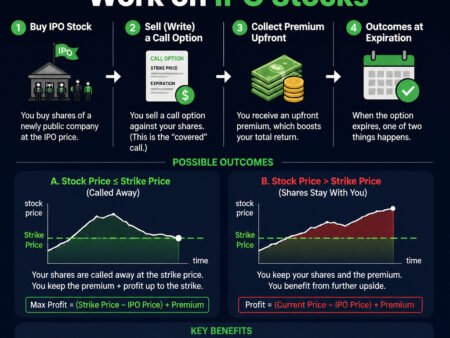
A covered call is an income strategy where you own at least 100 shares of a stock and sell a call option against those shares, collecting premium upfront.
The call option gives the buyer the right to purchase your shares at the strike price before expiration. In exchange for granting that right, you receive the premium immediately — regardless of what the stock does.
If the option expires worthless — meaning the stock stays below your strike price — you keep the premium and your shares. You can then sell another call the following month and repeat the process.
If the stock rises above your strike price at expiration, your shares get called away at the strike price. You keep the premium plus any gain from the stock’s rise to the strike. The only thing you give up is the upside above the strike.
For a broader introduction to options income see our guide on Options for Income. For a step-by-step beginner walkthrough see Covered Calls for Beginners.
The Key Components
Owning 100 Shares Each options contract controls 100 shares. To sell one covered call you need to own at least 100 shares of the underlying stock. To sell two contracts you need 200 shares, and so on.
Strike Price The strike price is the price at which your shares would be called away if the buyer exercises the option. Choosing the right strike is one of the most important decisions in covered call trading. See our complete guide on How to Pick the Right Strike Price.
Expiration Date The expiration date determines how long the option exists. Most income traders target the 30-45 days to expiration (DTE) window — this captures the steepest part of Theta decay while leaving enough time value in the option to make the premium worthwhile.
Premium The premium is what you collect when you sell the call. It’s deposited into your account immediately and is yours to keep regardless of outcome. For a complete breakdown of how premium is determined see our guide on How Options Pricing Works.
Example Covered Call Trade
Setup:
- Stock: Apple (AAPL)
- Current stock price: $180
- You sell: 1 AAPL $190 call
- Expiration: 30 days
- Premium: $2.00
- Premium collected: $200
Scenario 1 — Stock Stays Below Strike (Best Outcome) Apple remains below $190 at expiration. The option expires worthless.
- You keep the $200 premium
- You keep your 100 shares
- Annualized yield on this trade: approximately 13% on the $18,000 position
This is the ideal outcome. You collect income, retain your shares, and repeat next month.
Scenario 2 — Stock Rises Above Strike (Assignment) Apple rises to $200 at expiration. The buyer exercises the option.
- Your shares are sold at $190
- You keep the $200 premium
- Total profit: $1,000 (stock gain from $180 to $190) + $200 premium = $1,200
- The only thing you gave up was the gain above $190
Scenario 3 — Stock Falls Apple falls to $160 at expiration. The call expires worthless.
- You keep the $200 premium
- Your shares are now worth $16,000 instead of $18,000
- The $200 premium partially offsets the loss — your effective cost basis is now $178 instead of $180
The covered call doesn’t protect against large stock declines — but it does reduce your cost basis every time you collect premium.
How to Select the Right Strike Price
Strike selection is where most covered call traders make or lose their edge. The two key variables are Delta and distance from the current price.
The 20-35 Delta Range Most income traders target the 20-35 Delta range for covered calls. This means:
- 65-80% probability the option expires worthless — you keep the premium
- Meaningful premium collected — not so far out of the money that it’s barely worth selling
- Reasonable buffer before assignment risk becomes a concern
A 20 Delta call on a $180 stock might sit at a $195-200 strike — about 8-10% above the current price. A 35 Delta call might sit at $188-190 — about 5% above the current price. Higher Delta means more premium but higher assignment risk.
IV Rank Matters Sell covered calls when implied volatility is elevated — IV Rank above 30-50% is ideal. Higher IV means more premium for the same probability of success. Selling in low IV environments compresses premiums and makes the trade less worthwhile. See our guide on What Is Implied Volatility.
Strike Prices You’re Comfortable With Only sell covered calls at strike prices you’d be genuinely happy selling your shares at. If you’d be disappointed having Apple called away at $190, don’t sell the $190 call. Assignment is a normal part of covered call trading — your strike selection should reflect that.
The 30-45 DTE Window
The 30-45 days to expiration window is the standard entry point for covered call income traders. Here’s why:
Theta decay accelerates in the final 45 days before expiration. Selling in this window captures the steepest part of the decay curve — meaning the option loses value faster, which works in your favor as a seller.
Enough premium to justify the trade. Options with only 7-14 days remaining offer less premium for the same strike and often aren’t worth the effort relative to the risk of a quick adverse move.
Time to manage if needed. With 30-45 days remaining you have room to roll the position if the stock moves against you before being forced into a decision.
See our full guide on What Is Theta in Options for a complete breakdown of how time decay affects option pricing.
Managing Covered Call Positions
Opening a covered call is only half the job. Knowing how to manage it is what separates consistent income traders from frustrated ones.
The 50% Rule Many covered call traders close positions when they’ve captured 50% of the maximum premium — even if expiration is still weeks away. On a $200 premium, that means buying back the call for $100 and keeping $100 profit. Closing at 50% eliminates the risk of holding through the final weeks when Gamma accelerates and small stock moves create larger option price swings.
Rolling If the stock rises toward your strike before expiration, you can roll the covered call — closing the current position and opening a new one at a higher strike or later expiration. Rolling well means collecting a net credit — more premium on the new position than it costs to close the old one.
Rolling rules to follow:
- Only roll for a net credit — never pay to roll
- Rolling up and out (higher strike, later expiration) is the most common adjustment
- Don’t roll indefinitely — if the stock has broken out significantly, it may be better to accept assignment and start fresh
Accepting Assignment Assignment is not a loss — it’s a planned outcome. If your shares get called away at the strike price, you keep the premium plus any gain from the stock’s rise to the strike. You then have cash to sell cash-secured puts and potentially reacquire the stock at a lower price — which is the foundation of The Wheel Strategy.
The Income Math: What Monthly Returns Look Like
Understanding the realistic income potential of covered calls is important for setting expectations.
| Stock Price | Strike | Premium | Monthly Yield | Annualized |
|---|---|---|---|---|
| $50 | $55 | $0.75 | 1.5% | 18% |
| $100 | $108 | $1.50 | 1.5% | 18% |
| $150 | $160 | $2.50 | 1.7% | 20% |
| $200 | $215 | $3.50 | 1.75% | 21% |
These figures assume 30-35 Delta strikes in a normal IV environment. In high-IV environments the premiums — and yields — are meaningfully higher.
The compounding effect: If you own 300 shares of a $50 stock ($15,000 position) and consistently collect $75 per contract ($225/month for 3 contracts), that’s $2,700 annually — an 18% yield on your position before any stock appreciation.
When Covered Calls Work Best
Sideways markets — when stocks move sideways, options frequently expire worthless, allowing you to collect consistent premiums month after month without any adjustment needed.
Slightly bullish outlook — covered calls perform well when you expect modest gains. You participate in upside up to your strike and collect income if the stock stays flat.
High implied volatility environments — elevated IV inflates option premiums, meaning you collect more income for the same probability of success.
Long-term stock holdings — covered calls are ideal for stocks you plan to hold for years. The premium income compounds into a meaningful yield enhancement over time without changing your fundamental investment thesis.
When Covered Calls Don’t Work Well
Strongly bullish stocks — if you think the stock is about to make a significant move higher, selling a covered call caps that upside. Don’t sell covered calls on positions where you’re expecting a breakout.
Low implied volatility — when IV is compressed, premiums are thin and the trade may not generate enough income to justify the effort and assignment risk.
Stocks you’re not willing to sell — if you have a large unrealized gain with significant tax implications, having shares called away creates a taxable event. Understand the tax consequences of assignment before running covered calls on appreciated positions.
Covered Calls vs Cash-Secured Puts
Covered calls and cash-secured puts are closely related strategies that many income traders use together in a cycle called The Wheel.
| Covered Call | Cash-Secured Put | |
|---|---|---|
| Requires | 100 shares of stock | Cash to buy 100 shares |
| Collects | Call premium | Put premium |
| Best outcome | Option expires worthless | Option expires worthless |
| Assignment means | Shares sold at strike | Shares bought at strike |
| Best market | Flat to slightly rising | Flat to slightly falling |
The Wheel cycles between the two — selling puts to acquire stock at a target price, then selling covered calls to generate income on the shares, and repeating. See our complete guide on The Wheel Strategy.
Which Broker Is Best for Covered Calls?
Not all brokers are equal for covered call trading. Key factors are options approval process, per-contract fees, cash yield on idle capital, and analytical tools.
- tastytrade — $1 to open / $0 to close / $10 cap per leg. Best cost structure for high-volume covered call sellers. Portfolio-level Greeks and the tastylive education network
- Fidelity — $0.65 per contract with $0 exercise and assignment fees. 4.5%+ APY on idle cash automatically. Best for income traders who also hold long-term positions
- Charles Schwab (thinkorswim) — $0.65 per contract with the deepest options analytics platform in retail brokerage. Best probability visualizations and strategy modeling
- Robinhood / Webull / moomoo — $0 per contract. Good for simple covered call execution on lower-priced stocks
See our complete Best Options Brokers 2026 guide and Broker Fee Comparison for a full breakdown.
Final Thoughts
The covered call is the foundation of options income trading. It’s the strategy most income-focused traders learn first, use most consistently, and build their entire approach around.
Done well — targeting the right Delta, selling in elevated IV environments, managing positions at 50% profit, and rolling when appropriate — covered calls can generate 18-24% annualized yield enhancement on positions you’d hold anyway.
Done poorly — selling calls on stocks you don’t want to part with, chasing premium in low-IV environments, or holding through expiration without a plan — covered calls create frustration and missed upside.
The difference is process. Build a repeatable process around strike selection, expiration timing, and position management — and the income follows.
Ready to go further? See our complete Options for Income guide for a broader income strategy framework. New to options? Start with our How to Get Started With Options Trading page.
Frequently Asked Questions
What is a covered call strategy?
A covered call strategy involves owning at least 100 shares of a stock and selling a call option against those shares to generate premium income. You collect the premium immediately. If the stock stays below the strike price at expiration, the option expires worthless and you keep the premium and your shares. If the stock rises above the strike, your shares are sold at the strike price — you keep the premium plus any gain up to the strike.
How much money do you need to run a covered call strategy?
You need enough capital to own 100 shares of the underlying stock. A $50 stock requires $5,000 for 100 shares. A $150 stock requires $15,000. Most income traders recommend owning at least 300 shares across multiple positions to diversify premium income — which means $15,000-$50,000 is a practical starting point for a diversified covered call portfolio.
What happens if a covered call expires in the money?
If the stock rises above your strike price at expiration, the option buyer may exercise the contract and your shares are sold — called away — at the strike price. You keep the premium plus any gain from the stock’s price at purchase to the strike price. The only thing you give up is the stock’s appreciation above the strike.
Can you lose money on a covered call?
Yes — if the stock falls significantly the decline in share value will exceed the premium collected. The premium reduces your cost basis and partially offsets losses but does not eliminate downside risk. The covered call protects against small declines but not large ones. Your real risk in a covered call is always the stock position itself, not the option.
What is the best strike price for a covered call?
Most income traders target the 20-35 Delta range — strikes with approximately 65-80% probability of expiring worthless. This balances meaningful premium collection against acceptable assignment risk. The exact strike depends on your income target, how willing you are to part with the shares, and current implied volatility levels. See our complete guide on How to Pick the Right Strike Price.
When is the best time to sell covered calls?
The best time to sell covered calls is when implied volatility is elevated — IV Rank above 30-50% — in the 30-45 days to expiration window. High IV means more premium for the same probability. The 30-45 DTE window captures the steepest Theta decay. Combining both — high IV and the optimal DTE window — gives you the best risk/reward entry point.
What is the difference between a covered call and a naked call?
A covered call is backed by 100 shares you own — if the buyer exercises, you deliver shares you already hold. A naked call is sold without owning the underlying stock — if the buyer exercises, you must buy shares at market price to deliver them. Naked calls carry theoretically unlimited risk and require margin approval. Covered calls are one of the lowest-risk options strategies because the position is always backed by actual shares.
How does a covered call relate to The Wheel Strategy?
The Wheel Strategy combines covered calls and cash-secured puts in a cycle. You sell cash-secured puts to acquire stock at a target price, then sell covered calls once you own the shares to generate ongoing income, and if called away you return to selling puts. The covered call is the income-generating engine at the center of the Wheel. See our complete guide on The Wheel Strategy.