
Most investors buy stocks and wait. Covered calls change that equation — instead of waiting for your stock to go up, you get paid while you wait. Every month. On shares you already own.
This is the strategy that income-focused traders build their entire approach around — and it’s one of the few options strategies specifically designed to be lower risk than simply owning the stock outright. If you own 100 shares of anything, you can start selling covered calls today.
This guide walks you through exactly how it works, how to place your first trade step by step, and how to adapt the strategy as markets change.
New to options trading?
Start here: Options Trading for Beginners
Already familiar with the basics? Our Covered Call Strategy guide goes deeper on rolling, position management, and building a full income portfolio.
What Is a Covered Call?
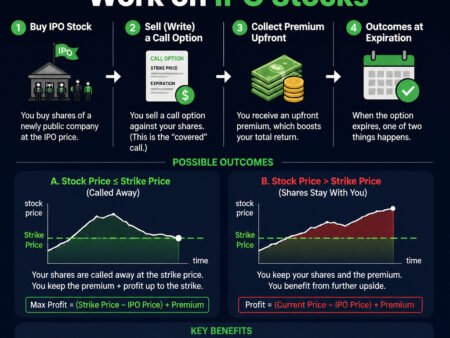
A covered call is an options strategy where you own at least 100 shares of a stock and sell a call option against those shares — collecting premium income upfront.
The word “covered” means your obligation is backed by shares you already own. If the buyer exercises the option and wants to buy your shares — you already have them. This is what makes covered calls one of the lowest-risk options strategies available. You’re not speculating. You’re monetizing shares you’d hold anyway.
In professional trading circles this is sometimes called a Buy-Write — buying the stock and writing (selling) the call simultaneously. As an existing shareholder you’re already halfway there.
The simple version: You set a price you’d be happy selling your shares at. Someone pays you cash today for the right to buy them at that price. If the stock stays below that price — you keep the cash and your shares. If it rises above — you sell at the price you agreed to and keep the cash. Either way you collected income.
For a complete breakdown of how the mechanics work at an intermediate level see our Covered Call Strategy guide.
The Three Essential Components
Every covered call has three moving parts. Understand these and the rest follows naturally.
1. The Underlying Shares You must own 100 shares of the stock for every 1 call contract you sell. 200 shares = 2 contracts. 500 shares = 5 contracts. No shares = no covered call. Selling calls without owning the shares is called a naked call — it carries unlimited risk and is something we never recommend at GainSumo.
2. The Strike Price The strike price is your agreed exit price — the level at which you’ve committed to sell your shares if the buyer exercises. Choose a strike you’d genuinely be happy selling at. If you’d be disappointed having shares called away at that price, go higher. See our complete guide on How to Pick the Right Strike Price.
3. The Expiration Date Options contracts have a fixed end date. After expiration the contract disappears — either having been exercised (your shares got called away) or expired worthless (you keep everything and start again). The expiration date determines how much time value is in the option — and therefore how much premium you collect.
How to Sell Your First Covered Call — 5 Steps
Here’s the exact mechanical process for placing your first covered call trade:
Step 1 — Confirm You Own 100 Shares
Check your brokerage account. You need exactly 100 shares (or a multiple of 100) of the stock you want to sell calls on. If you own 150 shares you can sell 1 contract. If you own 250 shares you can sell 2 contracts (with 50 shares uncovered — you’d typically just sell 2 contracts against the full 200 and hold 50 shares free).
Step 2 — Open the Options Chain
In your broker platform navigate to the stock’s options chain. This is the table showing all available call and put contracts at different strike prices and expiration dates. For a complete guide on reading the options chain see our How to Read the Options Chain guide.
Step 3 — Select Your Expiration Date
Choose an expiration approximately 30-45 days in the future. This window captures the steepest part of Theta decay — the daily erosion of an option’s time value that works in your favor as the seller. Weekly options decay fast but leave almost no time to manage if the stock moves. Monthly options beyond 45 days tie up capital too long for diminishing return per day. See our What Is Theta in Options guide for a complete explanation.
Step 4 — Choose Your Strike Price Using Delta
Look at the Delta column on the options chain. Delta measures how much the option moves per $1 stock move — but it also approximates the probability the option will finish in the money.
For covered calls most income traders target the 0.20-0.30 Delta range:
| Delta | Probability Option Expires Worthless | Best For |
|---|---|---|
| 0.10-0.15 | 85-90% | Conservative — lower premium, more upside room |
| 0.20-0.30 | 70-80% | Standard — best balance of income and probability |
| 0.40-0.50 | 50-60% | Aggressive — higher premium, higher assignment risk |
The 0.30 Delta strike is the most widely used starting point for income-focused covered call traders. It means approximately 70% probability of keeping your shares and 100% of the premium. For a deeper explanation see our What Is Delta in Options guide.
Step 5 — Execute a “Sell to Open” Order
Select the call option at your chosen strike and expiration. Choose “Sell to Open” — this opens a new short position. Always use a limit order rather than a market order. Set your limit price at or near the midpoint between the bid and ask prices. The premium is credited to your account immediately upon execution.
That’s it. You’ve sold a covered call.
A Real Example: Your First Covered Call Trade
Let’s walk through a complete trade on a stock accessible to most beginner accounts.
The Setup:
- Stock: Ford Motor (F) trading at $14.00
- You own: 100 shares (cost: $1,400)
- You sell: 1 F $15 Call, 35 days to expiration
- Premium collected: $0.35/share ($35 total)
- Monthly yield: 2.5% on the $1,400 position
What happens at expiration — three scenarios:
Scenario 1 — Stock stays below $15 (Best Outcome)
Ford closes at $13.80 at expiration. Your call expires worthless.
- You keep the $35 premium
- You keep your 100 shares
- Your effective cost basis drops from $14.00 to $13.65
- Next month you sell another call and repeat
Scenario 2 — Stock rises above $15 (Assignment)
Ford closes at $16.50 at expiration. Your call is assigned — shares sold at $15.
- Capital gain: $1.00/share × 100 = $100
- Premium collected: $35
- Total profit: $135 on a $1,400 position — a 9.6% return in 35 days
- You now have $1,535 in cash — return to Step 1 and sell a new put or buy new shares
Scenario 3 — Stock falls (Cushion)
Ford drops to $12.00 at expiration. Your call expires worthless.
- You keep the $35 premium — your only protection
- Your shares are worth $1,200 — a $200 unrealized loss
- Net position: -$165 instead of -$200
- Effective cost basis now $13.65 — premium reduced your loss
The premium doesn’t eliminate downside — it cushions it. On a stock that falls significantly the premium collected across multiple cycles provides meaningful cost basis reduction over time. This is why stock selection matters so much — you need to be genuinely comfortable holding through a decline.
How to Choose the Right Stock for Covered Calls
The most important covered call decision isn’t strike selection — it’s stock selection. You must be genuinely willing to own the stock through a 20-30% decline. If the stock drops that far and you want to sell — the covered call strategy has failed regardless of how much premium you collected.
What makes a good covered call stock:
You’d buy it outright anyway. The best covered call candidates are stocks you’d own for their business quality, not just for their premium. If you wouldn’t buy 100 shares at the current price without the covered call income — don’t buy them just for covered calls.
Accessible share price. 100 shares needs to fit within 10-15% of your total account. A $10 stock needs $1,000. A $30 stock needs $3,000. A $100 stock needs $10,000. Match the stock price to your account size.
Decent implied volatility. Higher implied volatility means richer premiums. Stocks with IV between 30-80% typically offer the best balance of meaningful income and manageable risk. For a complete explanation see our What Is Implied Volatility guide.
Liquid options chain. Check that your target strike has at least 200 contracts of open interest and a bid-ask spread under $0.15. Poor liquidity makes covered call execution expensive and rolling difficult.
No imminent binary events. Check the earnings calendar before selling. Don’t sell a covered call that expires after an earnings announcement without a specific plan.
Covered Calls in Different Market Conditions
One of the most important skills for covered call traders is adapting strike selection to the market environment. The same 0.30 Delta rule doesn’t apply equally in all conditions.
In a Bull Market — Go Further Out
When the market is trending strongly higher give your stock more room to run. Selling too close to the current price in a strong bull market means your shares get called away repeatedly — you collect small premiums but miss the larger trend move.
Target: 0.10-0.20 Delta strikes in strong bull markets. Less income per cycle but you maintain your stock exposure through the trend.
In a Sideways Market — Sell Closer In
A range-bound, choppy market is the best environment for covered calls. The stock isn’t going anywhere so you can sell closer to the current price and collect maximum premium without serious assignment risk.
Target: 0.30-0.45 Delta strikes in sideways markets. More income per cycle with lower risk of the stock breaking out and leaving your shares behind.
In a Bear Market — Prioritize Cushion
In a downtrend the goal shifts from income maximization to capital preservation. Selling calls closer to the current price generates more premium to offset the stock’s decline — but be careful not to sell so close that you cap potential recovery rallies.
Target: 0.30-0.40 Delta strikes in bear markets. Use the premium income to reduce cost basis while the stock finds its floor.
Rolling: What to Do When the Stock Moves Against You
Rolling is the covered call trader’s primary management tool — adjusting a position before it reaches expiration when the stock has moved significantly.
When to consider rolling:
- The stock has risen toward or above your strike with significant time remaining
- You want to keep the shares rather than let them get called away
- You can roll for a net credit — collecting more on the new position than it costs to close the old one
How rolling works:
- Buy to Close your current call (this costs money)
- Sell to Open a new call at a higher strike and/or later expiration (this generates premium)
- The net result should be a credit — more coming in than going out
The cardinal rule: only roll for net credit. Never pay to roll. If you can’t collect a net credit on the roll — either accept assignment or wait for better conditions before rolling.
Rolling Up and Out — closing your current strike and selling a higher strike at a later expiration — is the most common adjustment. You give the stock more room to rise while collecting additional premium and extending your income timeline.
For a complete rolling guide with specific examples see our Covered Call Strategy guide.
The Hidden Risk: Dividend Stocks and Early Assignment
If you sell covered calls on dividend-paying stocks there’s one specific risk most beginners don’t know about until it happens to them — early assignment before the ex-dividend date.
How it works: Call option buyers can exercise their contracts early — before expiration — to capture an upcoming dividend. If the extrinsic value remaining in your call is less than the upcoming dividend amount, the buyer has a financial incentive to exercise early and receive the dividend on your shares.
Example:
- You own 100 shares of a stock paying a $0.50 dividend
- You sold a call with $0.30 of extrinsic value remaining
- The buyer exercises early — capturing the $0.50 dividend at a cost of only $0.30 in forfeited time value
- You wake up assigned — shares gone before the ex-dividend date
How to protect yourself: Check the ex-dividend date before selling any covered call on a dividend-paying stock. If the call’s remaining extrinsic value is less than the upcoming dividend — close or roll the position at least 48 hours before the ex-dividend date.
For a complete explanation of assignment and early assignment see our What Is Assignment in Options Trading guide.
What Happens When Your Shares Get Called Away
Assignment isn’t a loss — it’s the strategy completing as designed. Here’s what actually happens:
- Your 100 shares disappear from your account
- Cash equal to strike price × 100 is credited instantly
- The options contract disappears
- You keep all premium collected
You’re now back to 100% cash. This is the start of Phase 3 of The Wheel Strategy — you can now sell cash-secured puts to potentially reacquire the stock at a lower price while collecting more premium.
Many income traders specifically target assignment as the ideal outcome — selling shares at a planned price, collecting premium along the way, and cycling back into the position through put selling.
Tax Considerations
Options income has specific tax treatment worth understanding before you start — especially if you’re running covered calls in a taxable account.
Premium income: Premiums collected from covered calls are generally treated as short-term capital gains — taxed at your ordinary income tax rate regardless of how long you’ve held the stock.
Unqualified covered calls: Selling a covered call that is deep in the money can in some circumstances reset the holding period of your underlying shares — potentially converting long-term capital gains into short-term gains on the stock position. This applies specifically to calls sold at or below the stock’s current price — not the standard out-of-the-money covered calls most income traders sell.
IRA accounts: Covered calls are permitted in most IRA accounts and premium income in an IRA grows tax-deferred (Traditional) or tax-free (Roth). Many income traders specifically run covered calls in IRAs for this reason.
Important: Tax treatment is complex and situation-specific. Consult a qualified tax professional before making investment decisions based on tax considerations.
Covered Calls vs Simply Holding Stock
| Factor | Buy and Hold | Covered Calls |
|---|---|---|
| Monthly cash flow | Dividends only (quarterly) | Premium income monthly |
| Downside protection | None | Premium cushions losses |
| Upside potential | Unlimited | Capped at strike price |
| Active management | Passive | Monthly — 15-30 min/position |
| Best market | Strong bull | Flat to slightly bullish |
| Worst market | Strong bear | Strong bear (limited cushion) |
| IRA eligible | Yes | Yes |
The covered call strategy consistently outperforms buy-and-hold in flat and range-bound markets. It underperforms in strong bull markets where the stock runs significantly above your strike — you collect premium but miss the full appreciation. That tradeoff is the core characteristic of the strategy — accept a cap on upside in exchange for consistent income.
Which Broker Is Best for Beginner Covered Call Traders?
The broker you start with matters more than most beginners expect. Options approval, per-contract fees, and available tools all affect your experience.
- Robinhood — $0 per contract, easiest options approval process, cleanest interface. Best for first covered calls on lower-priced stocks. Straightforward execution with no fee friction
- Webull — $0 per contract, free Level 2 market data, best paper trading environment to practice before risking real capital. Highly recommended for beginners who want to simulate covered calls first
- Fidelity — $0.65 per contract but $0 exercise and assignment fees — important when you get assigned. Best education library of any broker in this series. Strong retirement account support for IRA covered calls
- tastytrade — $1 to open / $0 to close / $10 cap per leg. Purpose-built for options income traders with the tastylive education network streaming live covered call examples daily
See our complete Best Options Brokers 2026 guide and Broker Fee Comparison for a full breakdown across 17 platforms.
Final Thoughts
The covered call is the strategy that turns a static stock portfolio into a cash-generating income machine. You already own the shares. You’re already accepting the risk of holding them. The covered call simply adds an income layer on top — getting paid every month for a commitment you’ve already made.
Start with one position on a stock you know well and would hold anyway. Pick a 0.30 Delta strike at 30-45 days to expiration. Use a limit order. Collect the premium. Watch what happens at expiration. That first cycle teaches you more than any guide can — because you’ll see exactly how Theta decay works, what assignment feels like when it happens, and how the income compounds when you run the next cycle.
The path from one covered call to a systematic $1,000+ monthly income portfolio is a process of repetition and scaling — not a single trade. Start small. Learn the mechanics. Scale what works.
Ready to go deeper? See our complete Covered Call Strategy guide for rolling, position management, and building a full income portfolio. For the broader income framework covered calls fit into see our Options for Income guide. New to the site? Start with our How to Get Started With Options Trading page.
Frequently Asked Questions
What is a covered call in simple terms?
A covered call is when you own 100 shares of a stock and sell someone else the right to buy those shares at a specific price by a specific date — collecting cash (premium) upfront for making that agreement. If the stock stays below your agreed price at expiration you keep the cash and your shares. If it rises above you sell your shares at the agreed price and keep the cash. Either way you collected income.
How much money do you need to sell covered calls?
You need enough to own 100 shares of your target stock. A $10 stock requires $1,000. A $20 stock requires $2,000. A $50 stock requires $5,000. Most beginners start with lower-priced stocks to keep capital requirements manageable while learning the mechanics. You also need options trading approval from your broker — typically Level 1 or Level 2 which most brokers grant quickly for covered calls.
Can you lose money selling covered calls?
Yes — if the stock price drops significantly your loss on the shares will exceed the premium collected. The premium cushions the decline but doesn’t eliminate it. This is why stock selection is the most important covered call decision — only sell covered calls on stocks you’d be comfortable holding through a 20-30% decline. The premium income is meaningful but it’s not a substitute for owning quality stocks.
Can I sell covered calls in an IRA?
Yes — most brokers allow covered calls in Traditional and Roth IRA accounts. It’s generally considered a conservative income strategy that most custodians approve at the standard options level. Premium income in a Roth IRA grows tax-free — making it one of the most tax-efficient uses of covered calls available. Check with your specific broker for their IRA options approval process.
What is the best strike price for a covered call?
Most income-focused beginners target the 0.20-0.30 Delta range — strikes with approximately 70-80% probability of expiring worthless. This balances meaningful premium collection against acceptable assignment risk. The specific strike depends on your income target, how willing you are to part with shares at that price, and current implied volatility. Only sell at strikes you’d genuinely be satisfied selling your shares at. See our complete How to Pick the Right Strike Price guide.
What happens when a covered call gets assigned?
Your 100 shares are sold at the strike price and cash is credited to your account. The options contract disappears. You keep all premium collected. Assignment is not a loss — it’s the strategy completing as designed. You sold shares at the price you agreed to and collected income along the way. You can then use the cash to sell cash-secured puts and potentially reacquire the stock at a lower price — the beginning of The Wheel Strategy.
What is the best expiration date for covered calls?
Most income traders target expirations 30-45 days out. This window captures the steepest part of Theta decay — the daily erosion of time value that benefits option sellers. Weekly options decay fastest but leave almost no time to manage the position if the stock moves. Expirations beyond 45 days generate more total premium but tie up capital too long for diminishing daily income. The 30-45 day window is the standard for systematic covered call income. See our What Is Theta in Options guide.
How do I know when to roll a covered call?
Consider rolling when the stock has risen toward or above your strike price with significant time remaining before expiration and you want to keep the shares. The key rule: only roll for a net credit — the new position must generate more than it costs to close the current one. If you can’t roll for a net credit either accept assignment at your strike or wait for better conditions. Rolling for a debit — paying to extend the position — is rarely the right move. See our complete Covered Call Strategy guide for rolling examples.