
Small trading accounts face a challenge that larger portfolios don’t: every dollar of risk matters more. A single oversized trade can wipe out weeks of careful work. A string of cheap lottery-ticket options can slowly drain capital before you’ve had time to develop real judgment.
The good news is that options are actually well-suited to smaller accounts — more so than most beginners realize. The key is choosing strategies designed for capital efficiency rather than maximum leverage. Defined risk, low capital requirements, and consistent position sizing matter far more for small accounts than finding the “best” trade.
This guide covers the five most capital-efficient options strategies for small accounts, how to size positions correctly at different account levels, and what separates traders who grow small accounts from those who don’t.
For a broader introduction to options strategies see our guide on Options Trading for Beginners.
New to options trading?
Start here: Options Trading for Beginners
Why Small Accounts Require a Different Approach
Options contracts control 100 shares of stock — which means individual trades can become expensive quickly relative to a small account balance.
The math problem:
- Stock price: $150
- Call option premium: $6.00
- Contract cost: $600
- Account size: $3,000
- Position as % of account: 20%
A single $600 trade on a $3,000 account is 20% of total capital. Two losing trades back to back and you’ve lost 40% of your account before you’ve developed any real edge. This is how most small accounts get destroyed — not from one catastrophic trade but from consistently oversized positions that don’t leave room for the normal variance of options trading.
The solution isn’t to avoid options — it’s to choose strategies with lower capital requirements and stricter position sizing.
The biggest mistake small account traders make: Buying cheap out-of-the-money options because they look affordable.
Example:
- Stock price: $100
- Call strike: $130
- Premium: $0.40
- Cost: $40
Forty dollars feels like manageable risk. But a $130 strike on a $100 stock requires a 30% move before expiration to reach profitability. These options expire worthless the vast majority of the time — and buying them repeatedly is one of the most reliable ways to slowly drain a small account. Low price does not mean low risk. It means low probability.
The 5 Best Options Strategies for Small Accounts
Strategy 1: Bull Call Spreads (Vertical Debit Spreads)
Capital required: $150-$400 per spread Max loss: Net debit paid Max profit: Spread width minus debit Best for: Bullish directional trades with capped cost
A bull call spread involves buying one call option and simultaneously selling a higher-strike call option on the same stock with the same expiration. The sold call partially funds the bought call — reducing your net cost and your maximum loss significantly compared to buying a naked call.
Example:
- Stock: Nvidia (NVDA) at $120
- Buy the $120 call for $4.00
- Sell the $130 call for $1.50
- Net debit: $2.50 per share
- Total cost: $250
| Outcome | Result |
|---|---|
| NVDA above $130 at expiration | Maximum profit: $750 ($10 spread – $2.50 cost × 100) |
| NVDA between $120-$130 | Partial profit or partial loss |
| NVDA below $120 | Maximum loss: $250 |
Why it works for small accounts: Buying the naked $120 call alone costs $400. The spread costs $250 — 37% less capital at risk for the same directional exposure. The tradeoff is capped upside — you don’t participate above $130. For small accounts this tradeoff is almost always worth making.
For a complete breakdown see our guide on Credit Spreads vs Debit Spreads.
Strategy 2: Bull Put Spreads (Vertical Credit Spreads)
Capital required: $150-$400 per spread (held as margin) Max loss: Spread width minus credit collected Max profit: Credit collected Best for: Neutral to bullish outlook — profiting from a stock staying above a level
A bull put spread involves selling an OTM put and buying a lower-strike put as protection. You collect a net credit and profit if the stock stays above your short strike at expiration. It’s the credit spread equivalent of the bull call spread — same defined risk, different mechanics.
Example:
- Stock: Apple (AAPL) at $180
- Sell the $170 put for $2.50
- Buy the $165 put for $1.00
- Net credit: $1.50 per share
- Total credit collected: $150
- Maximum loss: $350 ($5 spread – $1.50 credit × 100)
| Outcome | Result |
|---|---|
| AAPL above $170 at expiration | Maximum profit: $150 |
| AAPL between $165-$170 | Partial loss |
| AAPL below $165 | Maximum loss: $350 |
Why it works for small accounts: You collect income upfront with defined maximum loss. The capital tied up as margin is only the maximum loss amount — $350 in this example. On a $5,000 account that’s 7% of capital — a manageable, appropriately sized position.
Strategy 3: Cash-Secured Puts on Lower-Priced Stocks
Capital required: Strike price × 100 shares Max loss: Strike price × 100 minus premium collected Max profit: Premium collected Best for: Generating income while targeting stock acquisition at a discount
A cash-secured put involves selling a put option while holding enough cash to buy 100 shares if assigned. You collect premium immediately. If the stock stays above your strike at expiration, the put expires worthless and you keep the premium. If the stock falls below your strike, you’re assigned shares at an effective cost basis reduced by the premium.
The small account key: choose lower-priced stocks.
| Stock Price | Strike | Cash Required | Premium | Monthly Yield |
|---|---|---|---|---|
| $20 | $18 | $1,800 | $0.40 | 2.2% |
| $30 | $27 | $2,700 | $0.65 | 2.4% |
| $50 | $45 | $4,500 | $1.10 | 2.4% |
| $100 | $90 | $9,000 | $2.00 | 2.2% |
On a $5,000 account, a cash-secured put on a $20-$30 stock is manageable. A cash-secured put on a $100 stock ties up $9,000 — nearly double the account. Stock price selection is the most important capital efficiency decision for small account cash-secured put traders.
For a complete guide see our Covered Call Strategy and The Wheel Strategy.
For a complete breakdown of assignment risk see our guide on What Is Assignment in Options Trading.
Strategy 4: Covered Calls on Lower-Priced Stocks
Capital required: 100 shares of the underlying stock Max loss: Stock declining below purchase price (reduced by premium) Max profit: Premium collected plus stock gain up to strike Best for: Generating income from existing stock positions
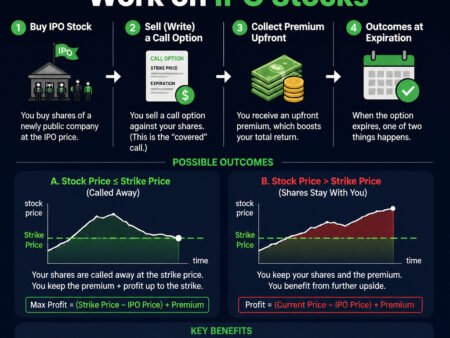
Covered calls require owning 100 shares — which means they’re only viable for small accounts on lower-priced stocks. The strategy involves selling a call option against shares you own and collecting premium. If the stock stays below your strike at expiration, you keep the premium and your shares. Repeat monthly.
Making covered calls work for small accounts:
| Stock Price | Cost for 100 Shares | Monthly Premium (2%) | Annual Yield |
|---|---|---|---|
| $15 | $1,500 | $0.30 ($30) | 24% |
| $25 | $2,500 | $0.50 ($50) | 24% |
| $40 | $4,000 | $0.80 ($80) | 24% |
| $50 | $5,000 | $1.00 ($100) | 24% |
Covered calls become realistic for small accounts when targeting stocks in the $15-$40 range. A $20 stock requires $2,000 to own 100 shares — accessible for most small accounts. A $200 stock requires $20,000 — not accessible.
The Wheel Strategy combines covered calls and cash-secured puts in a cycle — selling puts to acquire stock at a target price, then selling covered calls on the shares. It’s one of the most systematic income approaches for small accounts that are growing toward larger positions. See our complete guide on The Wheel Strategy.
Strategy 5: Iron Condors on ETFs
Capital required: $150-$400 per condor Max loss: Spread width minus total credit collected Max profit: Total credit collected Best for: Generating income in range-bound markets without stock ownership
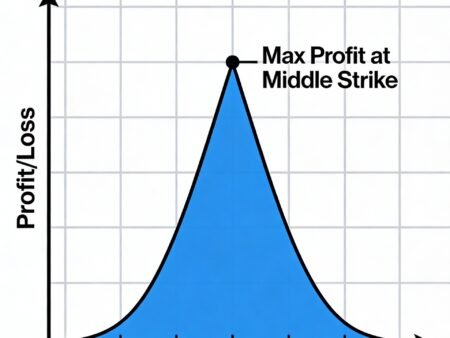
An iron condor combines a bull put spread and a bear call spread on the same underlying — creating a defined profit zone above and below the current price. You collect a net credit and profit if the stock stays within your range at expiration. Both sides have defined maximum loss.
Why ETFs specifically for small accounts: ETFs like SPY, QQQ, and IWM are among the most liquid options markets in the world — tight bid-ask spreads and high open interest make them easy to enter and exit. Lower per-share prices also mean lower absolute dollar risk per spread compared to high-priced individual stocks.
Example on SPY at $450:
- Sell the $460 call / Buy the $465 call → collect $0.80
- Sell the $440 put / Buy the $435 put → collect $0.70
- Total credit: $1.50
- Maximum profit: $150
- Maximum loss: $350 ($5 spread – $1.50 credit × 100)
If SPY stays between $440 and $460 at expiration — which it does more often than not — you keep the full $150 credit.
For a complete breakdown see our Iron Condor Strategy guide.
Position Sizing for Small Accounts
Position sizing is more important than strategy selection for small account traders. A great strategy with poor position sizing destroys accounts. A decent strategy with excellent position sizing survives and grows.
The 1-5% rule: Risk no more than 1-5% of your total account on any single trade.
| Account Size | 2% Max Risk | 5% Max Risk | Appropriate Strategy |
|---|---|---|---|
| $2,000 | $40 | $100 | Small debit spreads on lower-priced stocks |
| $3,000 | $60 | $150 | Bull call spreads, bull put spreads |
| $5,000 | $100 | $250 | All spread strategies, cash-secured puts on $20-$30 stocks |
| $10,000 | $200 | $500 | Full range of defined-risk strategies |
| $15,000 | $300 | $750 | Covered calls on $50-$100 stocks become viable |
The compounding effect: A $3,000 account targeting 3% monthly return generates $90/month. That sounds small — but reinvested consistently:
| Year | Account Value |
|---|---|
| Start | $3,000 |
| Year 1 | $4,300 |
| Year 2 | $6,200 |
| Year 3 | $8,900 |
| Year 4 | $12,700 |
| Year 5 | $18,200 |
The growth feels slow at first and accelerates dramatically as the account grows. This is why consistency matters more than any individual trade — and why protecting your account from large losses is more important than maximizing any single winner.
Why Broker Selection Matters More for Small Accounts
Per-contract fees eat a higher percentage of smaller premium amounts — making broker selection more consequential for small accounts than for large ones.
The math:
- Premium collected on a spread: $1.50 ($150)
- Fee at $0.65/contract × 4 legs: $2.60
- Fee as % of premium: 1.7%
- Same spread at $0/contract (Webull, Robinhood, moomoo):
- Fee: $0
- Fee as % of premium: 0%
At $0.65 per contract on a four-leg iron condor, you’re paying $2.60 in fees on what might be a $150 trade — almost 2% of your maximum profit before the trade even moves. For small account traders running multiple spreads per month, zero-fee brokers are a meaningful structural advantage.
Best brokers for small account options traders:
- Webull — $0 per contract, free Level 2 data, paper trading to practice before risking real capital. Best overall for small accounts
- Robinhood — $0 per contract, cleanest interface, easiest approval process
- moomoo — $0 per contract, free Level 2 data, strong charting tools
- tastytrade — $1 to open / $0 to close / $10 cap per leg. Best for active small account traders running multiple spreads — the $10 cap is a structural advantage at higher contract counts
See our complete Best Options Brokers 2026 guide and Broker Fee Comparison for a full breakdown.
Risk Management Rules for Small Accounts
Never risk more than 5% per trade. One bad trade should never materially damage your account. If it can, the position is too large.
Use limit orders always. Options bid-ask spreads can be wide — market orders give away money unnecessarily. Always use limit orders and target fills at or near the midpoint between bid and ask.
Close at 50% of maximum profit. Don’t hold short premium positions to expiration hoping for the last few dollars. Close at 50% profit, free up the capital, and move to the next trade. This rule alone significantly improves risk-adjusted returns on spread strategies.
Avoid holding options through expiration. Gamma risk accelerates dramatically in the final week before expiration. Positions that look safe with 21 days remaining can move against you quickly in the final days. See our complete guide on Managing Risk in Options Trading.
Focus on liquid underlyings. SPY, QQQ, AAPL, NVDA, MSFT — stocks and ETFs with high open interest and tight bid-ask spreads. Illiquid options are expensive to enter and exit and can trap small account traders in positions they can’t get out of at fair prices.
Don’t average down on losing positions. Adding to a losing options position to reduce average cost is one of the most reliable ways to turn a manageable loss into an account-damaging one. Take the loss, reset, and move to the next trade.
Realistic Growth Expectations
Small accounts rarely grow quickly without taking large risks — and large risks are exactly what destroys small accounts. The traders who build small accounts into meaningful portfolios do it through consistency, not through home run swings.
Realistic target: 2-4% monthly return on capital at risk.
This is not a guarantee — it’s a realistic range for a well-managed income portfolio running defined-risk strategies in favorable conditions. Some months will be better, some worse, and occasionally a losing month erases a portion of previous gains.
The growth becomes meaningful over time through compounding — not through any single trade. A $5,000 account targeting 3% monthly generates $150/month in year one. By year three the same percentage return generates $250-$300/month as the account grows. By year five it approaches $500/month.
That’s the real edge of options income strategies for small accounts — not explosive gains, but compounding systematic income that builds a larger and larger base over time.
Final Thoughts
Small accounts require discipline that larger accounts can sometimes afford to skip. Every dollar of capital matters. Every position size decision matters. Every fee matters.
The five strategies in this guide — bull call spreads, bull put spreads, cash-secured puts on lower-priced stocks, covered calls on affordable stocks, and iron condors on ETFs — give small account traders the best combination of capital efficiency, defined risk, and consistent income potential.
Start with one strategy, learn it thoroughly, and trade it consistently before adding complexity. The traders who grow small accounts into meaningful portfolios are almost always the ones who mastered one approach rather than constantly chasing new strategies.
When you’re ready to build a systematic income framework around these strategies see our complete guide on Options for Income. New to the site? Start with our How to Get Started With Options Trading page.
Frequently Asked Questions
What is the best options strategy for a small account?
Bull call spreads and bull put spreads are the most capital-efficient strategies for small accounts — they provide directional or neutral exposure with defined maximum loss and lower capital requirements than buying naked options or selling cash-secured puts. Iron condors on liquid ETFs like SPY are the best income strategy for small accounts that don’t yet have enough capital for covered calls or cash-secured puts on higher-priced stocks.
How much money do you need to trade options with a small account?
Many brokers allow options trading with accounts under $1,000 though practical flexibility improves significantly above $3,000-$5,000. At $3,000 you can trade vertical spreads with appropriate position sizing. At $5,000 cash-secured puts on $20-$30 stocks become viable. At $10,000-$15,000 covered calls on a range of stocks become accessible.
Are spreads better than buying options for small accounts?
Generally yes. Vertical spreads reduce your maximum loss, lower your capital requirement, and reduce your exposure to time decay compared to buying naked options. The tradeoff is capped upside — but for small accounts the capital efficiency and risk reduction of spreads almost always outweighs the unlimited upside of naked long options.
Can you grow a small options account quickly?
Rapid growth requires taking large risks — and large risks are exactly what destroys small accounts. The more reliable approach is targeting 2-4% monthly return on capital at risk through consistent defined-risk strategies and strict position sizing. This feels slow initially but compounds meaningfully over 3-5 years. Aggressive trading in small accounts consistently produces the opposite of rapid growth.
What position size should I use for a small options account?
Risk no more than 1-5% of your total account on any single trade. On a $3,000 account that’s $30-$150 maximum risk per position. On a $5,000 account that’s $50-$250. This sizing prevents any single trade from materially damaging your account and gives you enough trades to develop real judgment before making larger commitments.
Why do cheap out-of-the-money options destroy small accounts? Deep out-of-the-money options appear affordable — $0.30-$0.50 per contract feels like low risk. But their low price reflects low probability of success. A $130 call on a $100 stock requires a 30%+ move before expiration. These options expire worthless the vast majority of the time. Repeatedly buying cheap OTM options is one of the most reliable ways to slowly drain a small account over months of seemingly small losses.
Does broker choice matter more for small accounts?
Yes — significantly. Per-contract fees represent a higher percentage of smaller premium amounts. On a $150 spread trade, $2.60 in fees at $0.65/contract is nearly 2% of maximum profit before the trade moves. Zero-fee brokers like Webull, Robinhood, and moomoo eliminate this drag entirely — a meaningful structural advantage for small account traders running multiple spreads per month.