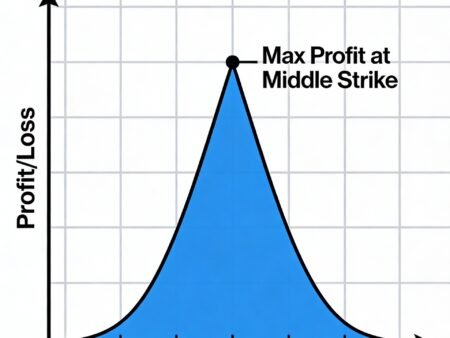

Most options strategies ask you to predict direction. The iron condor doesn’t. It asks you to predict that a stock will stay within a range — and pays you premium income for being right.
In a market that spends more time moving sideways than trending dramatically in either direction, that’s a genuine edge. The iron condor is the most widely used neutral options strategy among retail income traders for a simple reason: it generates consistent income in exactly the market conditions where directional traders struggle.
This guide covers how the iron condor works, how to select strikes, how to manage positions, and how to use it as a systematic monthly income strategy.
New to options strategies? Start with our Options for Income guide before diving into specific setups.
What Is an Iron Condor?
An iron condor is a four-legged options strategy that combines a bull put spread and a bear call spread on the same underlying asset with the same expiration date. You collect a net credit when you enter and keep that credit as profit if the stock stays within a defined price range at expiration.
The strategy has three possible outcomes:
- Stock stays in range — both spreads expire worthless, you keep the full credit
- Stock breaches one side — one spread loses value, your profit is reduced or eliminated
- Stock breaches both sides — theoretical maximum loss (rare but possible on extreme moves)
The iron condor belongs to the family of defined-risk credit spread strategies. Unlike selling naked options your maximum loss is known before you enter the trade — capped by the long options you own as protection on each side. For a complete breakdown of how credit spreads work see our Credit Spreads vs Debit Spreads guide.
The Four Legs Explained
An iron condor consists of four options contracts working together to create a profit zone above and below the current stock price.
The Put Side — Bull Put Spread (Your Floor)
- Short put — you sell an out-of-the-money put below the current price and collect premium. This is your lower boundary.
- Long put — you buy a further out-of-the-money put as protection. This caps your maximum loss if the stock falls dramatically.
The Call Side — Bear Call Spread (Your Ceiling)
- Short call — you sell an out-of-the-money call above the current price and collect premium. This is your upper boundary.
- Long call — you buy a further out-of-the-money call as protection. This caps your maximum loss if the stock rallies dramatically.
The two short strikes define your profit zone. The two long strikes define your maximum loss. Everything in between is income.
The Math: Profit, Loss, and Breakeven
Before placing any iron condor you need to know three numbers:
Maximum profit = Total net credit collected × 100 Maximum loss = (Spread width − net credit) × 100 Breakeven points = Short put strike − credit received / Short call strike + credit received
Example on SPY at $500:
- Sell $480 put / Buy $475 put → credit of $0.80
- Sell $520 call / Buy $525 call → credit of $0.80
- Total credit: $1.60 per share ($160 per iron condor)
- Maximum profit: $160 (SPY stays between $480 and $520)
- Maximum loss: $340 ([$5.00 spread width − $1.60 credit] × 100)
- Lower breakeven: $478.40 ($480 − $1.60)
- Upper breakeven: $521.60 ($520 + $1.60)
The 1/3 Rule: A widely used guideline for iron condor credit quality — the net credit collected should be at least 1/3 of the spread width. On a $5 wide spread that’s $1.67 minimum credit. Below this threshold the risk/reward doesn’t justify the trade. At $1.60 on a $5 spread the SPY example is right at this threshold — acceptable but on the thin side.
Scenario Analysis: Three Outcomes
Continuing the SPY at $500 example:
Scenario 1 — Stock Stays in Range (Full Profit)
SPY closes at $502 at expiration. All four options expire worthless.
- Result: Keep full $160 credit
- Return on risk: $160/$340 = 47% return on capital at risk
Scenario 2 — Stock Falls (Put Side Threatened)
SPY drops to $472 at expiration. Your short $480 put is $8 in the money.
- Your long $475 put offsets $5 of the loss
- Net loss on put spread: $5.00 − $1.60 credit = $3.40 per share
- Total loss: $340 (maximum loss)
Scenario 3 — Stock Rallies (Call Side Threatened)
SPY rallies to $530 at expiration. Your short $520 call is $10 in the money.
- Your long $525 call offsets $5 of the loss
- Net loss on call spread: $5.00 − $1.60 credit = $3.40 per share
- Total loss: $340 (maximum loss)
The maximum loss is identical whether the stock breaks up or down — which is why the iron condor is truly market-neutral. Direction doesn’t matter. Magnitude does.
How to Trade an Iron Condor: Step by Step
Step 1 — Identify the Right Underlying
Iron condors work best on underlyings with high implied volatility that you expect to decrease — or underlyings known for staying in a range. The best iron condor candidates are:
- Index ETFs: SPY, QQQ, IWM — deep liquidity, predictable ranges, tight spreads
- Large-cap stocks with elevated IV: Stocks with IV Rank above 50% offer richer premiums
- Stocks without major catalysts: Avoid earnings announcements, FDA decisions, or major news events within your expiration window
For a complete explanation of IV Rank and why it matters see our What Is Implied Volatility guide.
Step 2 — Choose Your Expiration
Target 30-45 days to expiration. This window captures the steepest Theta decay — the daily erosion of time value that works in your favor as a premium seller. Options with less than 21 days remaining have accelerating Gamma risk — small stock moves create large P&L swings. Options beyond 45 days generate more credit but tie up capital too long for diminishing daily income.
For a complete explanation see our What Is Theta in Options guide.
Step 3 — Select Your Strikes Using Delta
Professional traders use Delta to define strike probability rather than guessing. Delta approximates the probability the option will expire in the money — which means (1 − Delta) approximates the probability it will expire worthless.
Standard iron condor setup:
| Approach | Short Strike Delta | Probability of Profit | Premium | Risk |
|---|---|---|---|---|
| Conservative | 0.10 – 0.15 | ~80-85% combined | Lower | Lower |
| Standard | 0.15 – 0.20 | ~70-75% combined | Moderate | Moderate |
| Aggressive | 0.25 – 0.30 | ~55-65% combined | Higher | Higher |
The 0.15 Delta standard — selling the 15 Delta put and 15 Delta call — gives approximately 70% theoretical probability of success. This is the most widely used iron condor setup among retail income traders.
For a complete explanation of Delta see our What Is Delta in Options guide.
Step 4 — Verify the Credit Quality
Before executing confirm:
- Net credit is at least 1/3 of the spread width
- Bid-ask spreads are tight enough for fair fills — check open interest on all four legs
- IV Rank is above 30% — selling premium in low IV environments compresses credit below acceptable levels
Step 5 — Execute the Trade
Place the iron condor as a single multi-leg order — not four separate orders. Most brokers allow multi-leg order entry that fills all four legs simultaneously at a net credit. Use a limit order at the mid-price between the natural price and the mark. For a complete guide on reading the options chain see our How to Read the Options Chain guide.
Step 6 — Set Your Exit Plan Before Entering
Define these three exits before you place the order:
- Profit target: Close at 50% of maximum credit collected
- Loss limit: Close if the position reaches 2x the credit collected in losses
- Time stop: Close at 21 days to expiration regardless of profit or loss
The Real Probability Math
The 70% theoretical probability of profit sounds compelling — but it requires an important clarification most iron condor guides skip.
Theoretical PoP vs realized PoP are different numbers
The 0.15 Delta setup has approximately 85% probability on each side individually. But the two sides are not independent — a stock that moves far enough to breach one side is more likely to have momentum continuing in that direction. The real-world success rate on standard iron condors is typically 60-70% — meaningful but not as high as the raw Delta math implies.
The risk/reward reality:
- Win rate: approximately 65-70%
- Average win: full credit ($160 on the SPY example)
- Average loss: approaches maximum ($340 on the SPY example)
- Expected value per trade: ($160 × 0.67) − ($340 × 0.33) = $107 − $112 = approximately breakeven before commissions
This is why exit discipline matters so much for iron condors. Taking profits at 50% and cutting losses at 2x the credit collected significantly improves the expected value compared to holding to expiration. The math only works consistently with disciplined exits — not by holding every position to the end.
Best Market Conditions for Iron Condors
High IV environments — sell premium when it’s expensive
The ideal entry point for an iron condor is when implied volatility is elevated — IV Rank above 50% — and expected to decrease. When IV drops after your entry your options lose value rapidly even without the stock moving. This is called IV crush and it’s the iron condor trader’s best friend. For a complete explanation see our What Is IV Crush guide.
Range-bound or choppy markets
Iron condors thrive when stocks oscillate within a range rather than trending. Sideways markets that frustrate directional traders are the iron condor’s optimal environment.
After major volatility events
Post-earnings, post-Fed announcement, post-major news — IV typically spikes then collapses. Entering an iron condor immediately after a volatility event captures elevated IV that’s likely to decrease regardless of subsequent price movement.
When NOT to Use Iron Condors
Strong trending markets
A stock in a clear uptrend or downtrend will eventually breach your call or put spread. Iron condors are neutral strategies — they require range-bound conditions to work consistently. Don’t force iron condors on stocks showing strong directional momentum.
Low IV environments
When IV Rank is below 20% the premiums available don’t justify the capital committed and the risk taken. Low IV iron condors often generate credits of $0.50-$0.80 on $5 spreads — below the 1/3 rule threshold. Wait for IV to rise before selling.
Into major known catalysts
Never sell an iron condor that expires after an earnings announcement, FDA decision, or major event without a specific plan. These events regularly produce moves that exceed the iron condor’s profit zone. Iron condors on earnings require specific management — see our Best Options Strategy for Earnings guide.
On illiquid underlyings
Wide bid-ask spreads on any of the four legs make iron condors expensive to enter and exit. Always verify open interest above 500 contracts on all four legs before trading.
Iron Condors on Earnings
Iron condors are one of the most popular earnings strategies specifically because they profit from IV crush regardless of direction. The setup is the same but the timing is different — you enter 1-3 days before earnings when IV is elevated and exit the morning after when IV collapses.
The earnings iron condor advantage:
- IV is at peak levels — maximum premium collection
- IV crush happens regardless of direction — options lose value fast post-announcement
- Defined risk — you know your maximum loss before earnings hit
The earnings iron condor risk:
- The stock must stay within your profit zone despite the earnings move
- Position the short strikes at or just outside the expected move — the market’s implied forecast of the earnings move
- Calculate the expected move: ATM call price + ATM put price = approximate expected move in either direction
For a complete earnings options framework see our Best Options Strategy for Earnings guide.
Managing Iron Condor Positions
Opening an iron condor is only half the job. How you manage it determines whether the strategy generates consistent income.
Taking profits — the 50% rule Close the iron condor when you’ve captured 50% of the maximum credit. On the SPY example — enter at $1.60 credit, close when you can buy it back for $0.80. This eliminates the risk of holding through the final weeks when Gamma accelerates and small moves create large P&L swings. Most iron condor profits come in the first 1-2 weeks after entry — the remaining potential is rarely worth the additional risk.
Managing a losing position — three approaches
Option 1 — Do nothing If the stock is approaching one of your short strikes but hasn’t breached it — and your long wing is still providing protection — sometimes the best move is patience. If you sized the position correctly and the stock is still within your defined risk — let the trade play out.
Option 2 — Roll the unchallenged side If the stock is rising toward your short call — roll your put spread up toward the current price to collect additional credit and reduce your net risk.
Example: SPY rises from $500 to $515. Your $520 call is threatened. Roll the $480/$475 put spread up to $495/$490 — collecting an additional $0.40 credit. Your new net credit is $2.00 and your overall risk is reduced.
Only roll for a net credit — never pay to roll an iron condor. If you can’t collect credit on the roll — move to Option 3.
Option 3 — Close the trade If the position reaches 2x the credit collected in losses — close it. On the SPY example that means closing if the iron condor value reaches $3.20 (2x the $1.60 credit). This loss limit is non-negotiable. An iron condor approaching maximum loss is unlikely to recover — cutting at 2x preserves capital for the next cycle.
See our complete Managing Risk in Options Trading guide for the full framework.
Position Sizing for Iron Condors
Iron condors have defined risk — which makes position sizing straightforward. The capital at risk per iron condor is the maximum loss: spread width minus credit received times 100.
On the SPY example: ($5.00 − $1.60) × 100 = $340 per iron condor
The 5% rule for iron condors: Risk no more than 5% of your total account on any single iron condor position.
| Account Size | 5% Max Risk | Max Iron Condors ($5 spread) | Monthly Income Potential |
|---|---|---|---|
| $10,000 | $500 | 1 condor | ~$160 |
| $25,000 | $1,250 | 3 condors | ~$480 |
| $50,000 | $2,500 | 7 condors | ~$1,120 |
| $100,000 | $5,000 | 14 condors | ~$2,240 |
Income estimates based on $160 credit per condor at 50% profit target
Running multiple iron condors across different underlyings — SPY, QQQ, individual large-cap stocks — provides diversification that smooths monthly income variance.
Iron Condor vs Iron Butterfly
| Factor | Iron Condor | Iron Butterfly |
|---|---|---|
| Profit zone | Wide range | Narrow — stock must pin near current price |
| Probability of profit | Higher (~70%) | Lower (~50%) |
| Premium collected | Lower | Higher |
| Risk profile | Conservative | Aggressive |
| Best for | Beginners and income traders | Experienced traders with high conviction |
| Management | More forgiving | Requires precise exit timing |
The iron butterfly is essentially an iron condor with both short strikes at the same price — at the money. It collects maximum premium but requires the stock to close very near the current price at expiration. For most income traders the iron condor’s wider profit zone and higher probability make it the superior choice.
Which Broker Is Best for Iron Condors?
Iron condors require multi-leg order entry — four legs simultaneously. Not all brokers handle this equally well.
- tastytrade — $1 to open / $0 to close / $10 cap per leg. Purpose-built for multi-leg strategies. Portfolio-level Greeks, probability analysis, and the tastylive education network covering iron condors in depth daily. The industry standard for active iron condor traders
- Charles Schwab (thinkorswim) — best probability analysis tools in retail brokerage. The probability cone and expected move visualizations make iron condor strike selection intuitive. $0.65 per contract
- ETRADE (Power ETRADE) — browser-based strategy screener and multi-leg order entry. Probability calculator built in. $0.65/$0.50 active. Strong for iron condors specifically
- Robinhood / Webull — $0 per contract but limited multi-leg strategy tools. Acceptable for simple iron condors but less capable for adjustments and rolling
See our complete Best Options Brokers 2026 guide and Broker Fee Comparison for a full breakdown across 17 platforms.
Final Thoughts
The iron condor is the cornerstone strategy for traders who want to generate income from market stability rather than market direction. In flat and choppy markets where buy-and-hold investors earn nothing and directional traders get chopped up — the iron condor trader collects consistent premium income.
The key to making it work long-term is process: sell in high IV environments, target 0.15 Delta strikes, take profits at 50%, cut losses at 2x the credit, and never hold through major catalysts without a plan. That discipline separates iron condor traders who generate consistent monthly income from those who win six times and then give it all back on the seventh.
Ready to go deeper? See our complete Options for Income guide for the broader income strategy framework iron condors fit into. For using iron condors specifically around earnings see our Best Options Strategy for Earnings guide. New to the site? Start with our How to Get Started With Options Trading page.
Frequently Asked Questions
What is an iron condor in options trading?
An iron condor is a four-legged neutral options strategy that combines a bull put spread and a bear call spread on the same underlying with the same expiration. You collect a net credit upfront and keep it as profit if the stock stays within a defined price range at expiration. Maximum profit is the credit collected. Maximum loss is the spread width minus the credit — known before you enter the trade.
How does an iron condor make money?
An iron condor makes money through Theta decay — the daily erosion of time value that benefits option sellers — and IV crush — the collapse in implied volatility that reduces option prices. Both work in the iron condor seller’s favor simultaneously. The longer the stock stays within the profit zone the more the options decay toward zero and the more profit the trader captures.
What is the maximum loss on an iron condor?
Maximum loss equals the spread width minus the net credit received multiplied by 100. On a $5 wide spread with $1.60 credit collected — maximum loss is ($5.00 − $1.60) × 100 = $340 per iron condor. This loss is capped and defined before you enter the trade — it cannot exceed this amount regardless of how far the stock moves.
What Delta should I use for an iron condor?
Most income-focused iron condor traders target the 0.15 Delta range on both sides — the short put at 0.15 Delta and the short call at 0.15 Delta. This creates approximately 70% theoretical probability of success. Conservative traders use 0.10 Delta for higher probability and lower premium. Aggressive traders use 0.25-0.30 Delta for higher premium and lower probability. See our What Is Delta in Options guide.
When is the best time to sell an iron condor?
The best entry point is when implied volatility is elevated — IV Rank above 50% — in the 30-45 days to expiration window. High IV means richer premiums for the same probability. The 30-45 DTE window captures the steepest Theta decay curve. Combining both gives you maximum premium with maximum time for the trade to work in your favor.
Can I trade iron condors on earnings?
Yes — iron condors are one of the most popular earnings strategies because they profit from IV crush regardless of direction. Enter 1-3 days before earnings when IV is at peak levels. Position your short strikes at or just outside the expected move. Close the morning after earnings when IV collapses. The risk is that a larger-than-expected move breaches your profit zone. See our complete Best Options Strategy for Earnings guide.
What is the difference between an iron condor and an iron butterfly?
An iron condor sells two different short strikes — one put below the stock and one call above it — creating a wide profit zone. An iron butterfly sells both short strikes at the same price — at the money — creating a narrow profit zone centered on the current stock price. Iron condors have higher probability of profit and lower premium. Iron butterflies have lower probability but collect significantly more premium. Iron condors are more appropriate for most income traders.
How do I manage an iron condor that’s going against me?
Three options in order of preference: first do nothing if the stock is still within your defined risk and you have time remaining — sometimes patience is the right move. Second roll the unchallenged spread toward the current price to collect additional credit and reduce net risk — only do this for a net credit. Third close the entire position if it reaches 2x the credit collected in losses. Never let an iron condor approach maximum loss hoping for a recovery — the math rarely works out. See our Managing Risk in Options Trading guide.