
“Can you make $1,000 a month with options?” is one of the most searched questions in retail options trading — and one of the most honestly answered on very few sites. Most content either oversells the possibility with unrealistic claims or dismisses it entirely as too risky.
The real answer is more nuanced: yes, generating $1,000 per month with options is achievable — but the account size, strategy, and consistency required are significantly different from what most beginners expect. This guide breaks down exactly what it takes, what the math looks like, and what most traders get wrong when chasing a monthly income target.
The Short Answer – Yes
Generating $1,000 per month with options is achievable with the right account size, the right strategy, and realistic expectations about consistency.
The longer answer: $1,000 per month is a return target, not a guarantee. Options income is variable — some months you’ll exceed it, some months you’ll fall short, and occasionally a bad trade will cost you more than a month’s worth of gains. The traders who consistently hit income targets treat options as a systematic process, not a monthly paycheck.
The single most important variable is account size. The smaller your account, the higher the return percentage you need to generate $1,000 — and higher return targets require taking on more risk. Understanding this relationship is the foundation of realistic income planning with options.
The Math: What Account Size Do You Need?
Let’s work backwards from the $1,000 monthly target to understand what account size is required at different return rates.
| Monthly Target | Required Monthly Return | Account Size Needed |
|---|---|---|
| $1,000 | 5% | $20,000 |
| $1,000 | 4% | $25,000 |
| $1,000 | 3% | $33,333 |
| $1,000 | 2% | $50,000 |
| $1,000 | 1% | $100,000 |
The relationship is straightforward: the smaller your account, the higher the percentage return you need — and the more risk you have to take to generate it.
What is a realistic monthly return?
A sustainable, well-managed options income portfolio typically targets 2-4% per month on capital actively at risk — not on total account value. That distinction matters. Most income traders keep 30-50% of their portfolio in cash as a buffer, so the return on total account value is lower than the return on deployed capital.
A trader with a $50,000 account deploying $30,000 in covered calls and cash-secured puts targeting 3% monthly on deployed capital would generate approximately $900/month — close to the $1,000 target while keeping $20,000 in reserve.
The honest caveat: 2-4% monthly on deployed capital is achievable in favorable conditions but not guaranteed every month. Market volatility, assignment events, and losing trades create variance. Targeting $1,000/month consistently requires either a larger account, higher risk tolerance, or both.
The Best Strategies for Monthly Options Income
Not all options strategies are suited to generating consistent monthly income. The strategies that work best share one characteristic: they are net sellers of premium, meaning they collect cash upfront and profit as time passes and options decay.
1. Covered Calls
The covered call is the most widely used options income strategy and the most appropriate starting point for income-focused traders.
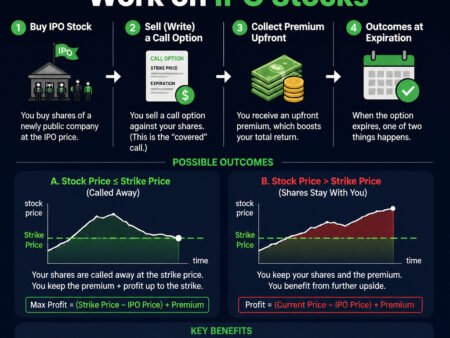
You own 100 shares of a stock and sell a call option against those shares each month, collecting premium. If the stock stays below your strike at expiration, the option expires worthless and you keep the premium. Repeat next month.
Income example:
- 200 shares of a $25 stock ($5,000 position)
- Sell 2 covered calls at the $27 strike for $0.60 each ($120 total per month)
- Annualized yield: approximately 28% on the position
Scale this across multiple positions and the income compounds. A trader with $50,000 deployed in covered call positions at an average monthly premium of 2.5% generates approximately $1,250/month.
For a complete breakdown see our guide on Covered Call Strategy.
2. Cash-Secured Puts
A cash-secured put involves selling a put option on a stock you’re willing to own, keeping enough cash in reserve to buy the shares if assigned. You collect premium each month. If the stock stays above your strike, the put expires worthless and you keep the premium.
Income example:
- $4,500 in cash reserved
- Sell a $45 put on a $48 stock for $0.90 ($90 per contract per month)
- Annualized yield: approximately 24% on the reserved capital
Cash-secured puts and covered calls are often combined in the Wheel Strategy — cycling between selling puts and covered calls on the same stock to generate income at every stage. See our guide on The Wheel Strategy.
3. Short Strangles and Iron Condors
For traders with intermediate to advanced experience, selling strangles and iron condors on high-IV underlyings generates premium income without requiring stock ownership.
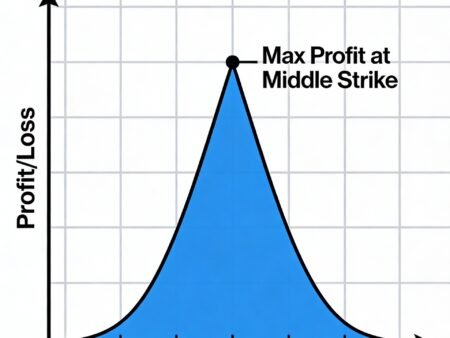
An iron condor on a $200 stock might collect $2.50-$4.00 in credit — $250-$400 per contract — with a defined maximum loss. Running 3-4 iron condors per month across different underlyings can contribute meaningfully to a $1,000 monthly target.
The key is selectivity — targeting underlyings with elevated IV Rank, liquid options chains, and predictable price behavior. See our guide on The Iron Condor Strategy.
A Realistic $1,000/Month Portfolio Blueprint
Here’s what a realistic income-generating options portfolio looks like at different account sizes.
$25,000 Account — Aggressive but Achievable
At $25,000 you need roughly 4% monthly return to hit $1,000 — which is on the aggressive end of sustainable. This requires:
- Deploying most of your capital in income positions
- Selecting higher-IV underlyings that generate more premium
- Accepting higher probability of assignment and occasional losing months
- Strict position sizing — no single position larger than 10-15% of the account
Realistic monthly range: $600-$1,400 with significant variance. Some months you’ll hit the target, others you won’t.
$50,000 Account — The Sweet Spot
At $50,000 you need 2% monthly return — a target that experienced income traders consistently achieve without taking excessive risk. This allows:
- Keeping 30-40% in cash as a buffer
- Diversifying across 8-12 positions in different sectors
- Targeting the 20-30 Delta range for covered calls and cash-secured puts
- Managing positions without desperation — you have room to roll and adjust
Realistic monthly range: $800-$1,500 with manageable variance. This is where $1,000/month becomes genuinely consistent rather than aspirational.
$100,000 Account — Comfortable and Conservative
At $100,000 you only need 1% monthly return — achievable with conservative, low-stress income strategies. This account size allows:
- Running 15-20 well-diversified positions
- Targeting lower-Delta strikes with higher probability of success
- Keeping 50% in cash without sacrificing the income target
- Weathering bad months without materially impacting the portfolio
Realistic monthly range: $800-$1,800 with low variance. At this account size, $1,000/month is sustainable and predictable.
The Variables That Determine Your Monthly Income
Five variables determine how much you can realistically generate each month.
1. Account size — the most important variable. More capital means lower required return percentage and more consistent income.
2. Implied volatility environment — in high-IV markets, premium is elevated and income strategies generate more per trade. In low-IV environments, premium is compressed and income targets are harder to hit without taking more risk.
3. Stock selection — stocks with higher implied volatility generate more premium. A covered call on a volatile tech stock might generate 3-4% monthly. A covered call on a slow-moving dividend stock might generate only 0.5-1%.
4. Strike selection — selling closer to at-the-money generates more premium but increases assignment risk. Selling further out of the money generates less premium but provides more buffer.
5. Consistency and compounding — reinvesting premium income into additional positions compounds the income over time. A trader who consistently reinvests monthly income grows both the account and the monthly income generation capacity simultaneously.
What Most Traders Get Wrong
Targeting a fixed dollar amount every month. Options income is variable — trying to hit exactly $1,000 every month leads to taking on more risk in slow months to compensate for lower premium. Better approach: target a consistent return percentage on deployed capital and let the dollar amount fluctuate.
Starting with too small an account. Trying to generate $1,000/month from a $10,000 account requires 10% monthly returns — which requires taking enormous risk. Small accounts are better served by focusing on growing the account first and targeting income later.
Ignoring the risk side of the equation. Premium income is not free money. Every covered call and cash-secured put comes with real obligations. Assignment events, stock downturns, and losing trades are part of the business. Monthly income targets need to be evaluated net of losses, not just gross premium collected.
Over-concentrating in one sector or stock. Running all your covered calls on tech stocks means a tech sector selloff hits every position simultaneously. Diversification across sectors and underlyings is essential for income consistency.
Neglecting cash yield on reserves. A $50,000 account keeping $20,000 in cash between trades should be earning meaningful yield on that cash. At 4.5% APY — available automatically at brokers like Fidelity — that’s $75/month in additional income without any options trading at all. For a complete breakdown of which brokers offer the best cash yield, see our Best Options Brokers 2026 guide.
Building to $1,000/Month: A Step-by-Step Approach
If you’re starting with a smaller account and working toward a $1,000 monthly income target, here’s a realistic progression:
Phase 1 — Under $15,000: Build the foundation Focus on learning rather than income. Run 2-3 covered calls or cash-secured puts per month on lower-priced stocks. Reinvest all premium into the account. Target is account growth, not income extraction.
Phase 2 — $15,000-$30,000: Start generating meaningful income Run 4-6 positions per month across different sectors. Target $300-$600/month in premium income. Reinvest 50-75% and take the rest as income if needed. Begin tracking return on deployed capital rather than just dollar amounts.
Phase 3 — $30,000-$50,000: Approach the target Run 8-10 positions per month. Target $700-$1,000/month in premium income. Full diversification across sectors and underlyings. Begin incorporating iron condors alongside covered calls and cash-secured puts.
Phase 4 — $50,000+: Consistent $1,000/month Full income portfolio. 10-15 positions per month. $1,000-$1,500/month target. Conservative strike selection, disciplined management, and consistent reinvestment of a portion of income to continue growing the portfolio.
How Long Does It Take?
This is the question most people want answered — and the honest answer depends almost entirely on starting capital and how aggressively you reinvest.
A trader starting with $10,000 and reinvesting all premium income could realistically reach $50,000 in 3-5 years, assuming consistent 2-3% monthly returns on deployed capital and no major account-damaging events. At that point the $1,000/month target becomes achievable.
A trader starting with $30,000 might reach the target in 12-24 months of consistent trading and reinvestment.
A trader who already has $50,000 can start targeting $1,000/month immediately — though it will take several months to build the experience and position management skills to hit the target consistently.
The fastest path is not the highest-risk path. Consistent, disciplined income trading with proper position sizing compounds more reliably than aggressive strategies that occasionally generate large losses requiring months to recover from.
Frequently Asked Questions
Can you realistically make $1,000 a month with options?
Yes — but it requires an appropriately sized account and realistic expectations. At a sustainable 2% monthly return on deployed capital, you need approximately $50,000 actively deployed to generate $1,000/month. Smaller accounts can hit the target but require higher return percentages and therefore higher risk. Most experienced income traders reach consistent $1,000/month generation with $40,000-$60,000 in their account.
What is the best options strategy for monthly income?
Covered calls and cash-secured puts are the most appropriate strategies for consistent monthly income — particularly for traders building toward an income target over time. They’re straightforward to manage, generate predictable premium, and work across a wide range of account sizes. The Wheel Strategy combines both in a systematic cycle. For larger accounts, adding short strangles and iron condors increases income potential.
How much money do I need to make $1,000 a month with options?
At a conservative 2% monthly return on deployed capital, you need $50,000 actively deployed. At 3% monthly return, you need approximately $33,000. At 4% monthly return — which is aggressive — you need $25,000. These figures assume all capital is deployed, which isn’t realistic — most traders keep 30-50% in cash as a buffer, so total account sizes of $40,000-$75,000 are typically needed depending on your target return rate.
Is options trading a reliable source of monthly income?
Options income is variable, not fixed. Unlike a dividend payment or bond coupon, the premium you generate each month fluctuates with implied volatility, market conditions, and the performance of your underlying stocks. Experienced income traders treat it as a range — targeting $800-$1,200/month rather than exactly $1,000 — and manage their lifestyle expenses around the lower end of that range.
What stocks are best for generating options income?
The best stocks for options income have elevated implied volatility (generating more premium), high liquidity in their options chain (tight bid-ask spreads), and stable or improving fundamentals (reducing the risk of catastrophic downside). Many income traders favor ETFs like SPY and QQQ for their liquidity, mid-cap technology stocks for their premium, and dividend stocks for the combination of income streams.
Can I make $1,000 a month with options on a $10,000 account?
Technically possible but not recommended. Generating $1,000/month from $10,000 requires 10% monthly returns — which requires taking significant risk. A single bad trade at that return level could wipe out multiple months of gains. A more realistic approach with a $10,000 account is targeting $150-$250/month in premium income while reinvesting consistently to grow the account toward a level where $1,000/month is achievable at sustainable risk levels.
How do taxes affect options income?
Options income is generally taxed as short-term capital gains — at your ordinary income tax rate — for positions held less than a year. This is an important consideration when calculating net income targets. A trader targeting $1,000/month gross may net $700-$800/month after taxes depending on their tax bracket. Consult a tax professional for guidance specific to your situation.
What broker is best for options income trading?
The best brokers for options income trading combine low per-contract fees, strong analytical tools for managing positions, and high cash yield on uninvested reserves. tastytrade offers the lowest fees for high-volume sellers with its $10 cap per leg. Fidelity offers 4.5%+ APY on idle cash automatically — important for income traders who keep reserves. See our complete Best Options Brokers 2026 guide for a full comparison.