
Most options strategies ask you to predict direction. The Wheel Strategy doesn’t. It asks you to pick a stock you’d be happy owning, get paid to wait for it at your target price, then get paid again while you hold it. Repeat indefinitely.
That’s the entire framework. The execution details matter — but the concept is straightforward enough that income-focused traders at every experience level can run it systematically and profitably.
This guide covers how The Wheel works phase by phase, how to select the right stocks, how to size positions, how to manage when things go wrong, and what realistic monthly income looks like when you run it consistently.
New to options trading?
Start here: Options Trading for Beginners
What Is The Wheel Strategy?
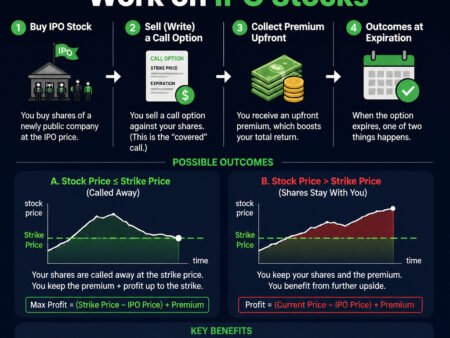
The Wheel Strategy — sometimes called the Triple Income Strategy — is a circular options income approach with three repeatable phases:
- Sell cash-secured puts to collect premium until assigned
- Own the stock — your put was exercised and you now hold 100 shares
- Sell covered calls against those shares until they get called away — then return to Phase 1
In every phase you’re collecting premium. The puts pay you to wait for the stock at your target price. The covered calls pay you to hold it once you own it. The cycle repeats as long as you want to keep running it on that stock.
The Wheel works because of Theta decay — the daily erosion of options extrinsic value as expiration approaches. As the seller of both puts and calls, time decay works in your favor every single day. You’re essentially running an insurance company — collecting consistent premiums by taking on obligations that most of the time never get triggered.
For a complete income strategy framework that incorporates The Wheel see our guide on Options for Income.
The Anatomy of The Wheel: You Are Always the Seller
In options trading every contract has two sides — a buyer and a seller. In The Wheel you are always the seller.
As the seller you take on an obligation in exchange for premium paid upfront:
- Selling a put: You’re obligated to buy 100 shares at the strike price if the stock falls below it by expiration
- Selling a covered call: You’re obligated to sell your 100 shares at the strike price if the stock rises above it by expiration
Buyers look for explosive moves. Wheel traders act like an insurance company — collecting small, consistent payments by accepting defined obligations on stocks they’d be happy owning anyway. The premium is yours to keep regardless of outcome.
Phase 1: Selling the Cash-Secured Put
The Wheel begins with a cash-secured put — selling the right for someone else to put shares to you at your chosen strike price.
What you’re saying to the market: “I’m willing to buy 100 shares of this stock at $X by Y date. Pay me today for making that promise.”
What “cash-secured” means: You keep enough cash in your account to buy the shares if assigned. On a $30 stock at a $28 strike, you need $2,800 reserved. This is not margin — it’s actual cash committed to the potential purchase.
Selecting your strike price using Delta:
Professional Wheel traders don’t guess strike prices — they use Delta. Delta measures the probability that an option will expire in the money. A put with 0.30 Delta has approximately a 30% chance of being assigned — and therefore a 70% chance of expiring worthless and keeping the full premium.
- Conservative entry: 0.15-0.20 Delta put — 80-85% probability of expiring worthless, lower premium
- Standard entry: 0.25-0.30 Delta put — 70-75% probability, better balance of premium and probability
- Aggressive entry: 0.35-0.40 Delta put — higher premium but meaningful assignment risk
Most income-focused Wheel traders target the 0.20-0.30 Delta range. For a complete guide on strike selection see our How to Pick the Right Strike Price guide.
The 30-45 DTE window:
Sell puts with 30-45 days to expiration. This window captures the steepest part of the Theta decay curve — options lose value fastest in the final 30-45 days. Selling further out captures more premium but ties up capital longer. Weekly options decay fastest but leave no time to manage if the stock moves against you — not appropriate for The Wheel. For a complete explanation see our What Is Theta in Options guide.
Phase 1 example:
- Stock: XYZ trading at $30
- You sell 1 put at the $27 strike (0.25 Delta), 35 days to expiration
- Premium collected: $0.65/share ($65 per contract)
- Cash reserved: $2,700
Outcome A — Stock stays above $27 at expiration: Option expires worthless. You keep the $65. Monthly yield: 2.4% on reserved capital. Return to Phase 1 next month on the same stock.
Outcome B — Stock falls to $25 at expiration: You’re assigned 100 shares at $27. Your effective cost basis: $27.00 – $0.65 = $26.35. You now own 100 shares at a better price than if you’d simply bought the stock at $30. Move to Phase 2.
For a complete explanation of how assignment works see our guide on What Is Assignment in Options Trading.
Phase 2: Selling the Covered Call
Now that you own 100 shares you shift your role. You’re no longer waiting to buy — you’re collecting rent on shares you already hold.
What you’re saying to the market: “I’m willing to sell my 100 shares at $X by Y date. Pay me today for that promise.”
Strike selection for covered calls:
Target strikes 10-20% above your cost basis — roughly the 0.25-0.35 Delta range. This generates meaningful premium while giving the stock room to move before your shares get called away.
The key principle: only sell covered calls at strikes you’d genuinely be happy having your shares sold at. If you’d be disappointed losing the stock at $29, don’t sell the $29 call. See our complete Covered Call Strategy guide for a full breakdown.
Phase 2 example:
Continuing from Phase 1 — you own 100 shares of XYZ with a $26.35 effective cost basis:
- You sell 1 call at the $30 strike (0.30 Delta), 35 days to expiration
- Premium collected: $0.55/share ($55 per contract)
- New effective cost basis: $26.35 – $0.55 = $25.80
Outcome A — Stock stays below $30 at expiration: Call expires worthless. You keep the $55 and your shares. Your cost basis has dropped again. Sell another call next month. Repeat.
Outcome B — Stock rises above $30 at expiration: Your shares are called away at $30. Move to Phase 3.
Phase 3: The Full Rotation
When your shares are called away the Wheel has completed a full cycle. Here’s the complete income accounting from our example:
| Amount | |
|---|---|
| Put premium collected | $65 |
| Covered call premium collected | $55 |
| Stock gain ($30 sale – $27 assignment) | $300 |
| Total profit on one rotation | $420 |
On a $2,700 position that’s a 15.6% return on one full cycle. Annualized over multiple cycles the income compounds meaningfully.
You are now back to 100% cash. Return to Phase 1 and start the cycle again — on the same stock or a new one.
Stock Selection: The Most Important Decision in The Wheel
The Wheel lives or dies on stock selection. This is where most beginners make their most expensive mistake — choosing stocks based on premium yield rather than on whether they’d genuinely want to own them through a significant drawdown.
The fundamental rule: Only Wheel stocks you’d be happy holding for 12-24 months if the price dropped 30-40% after assignment.
Characteristics of a good Wheel stock:
Strong underlying business. The Wheel amplifies your stock exposure. A speculative company with weak fundamentals can drop 50-70% on bad news — no amount of premium collection covers that kind of loss. Target companies with real revenue, growing businesses, and durable competitive positions.
Elevated implied volatility. Higher IV means richer premiums on both puts and calls. Stocks with IV Rank above 30-50% offer better income per dollar of capital than low-IV alternatives. But very high IV (above 100%) often signals genuine business risk — balance premium richness against fundamental quality. For a complete explanation see our What Is Implied Volatility guide.
Liquid options chain. You need to enter, exit, and roll positions efficiently. Target stocks with open interest above 500 contracts at your chosen strike and bid-ask spreads under $0.10 on near-term options. For a complete guide on evaluating liquidity see our How to Read the Options Chain guide.
Share price accessible to your account. One put contract requires enough cash to buy 100 shares. A $10 stock requires $1,000 in reserved capital. A $50 stock requires $5,000. A $200 stock requires $20,000. Match stock price to your account size to maintain proper position sizing.
No upcoming binary events. Avoid selling puts on stocks with imminent FDA decisions, major earnings announcements, or pending regulatory rulings unless you’ve specifically planned for the elevated volatility. See our guide on Best Options Strategy for Earnings.
Good Wheel candidates typically look like:
- Mid-cap to large-cap companies with proven business models
- Stocks you’ve researched and would buy outright anyway
- IV in the 30-80% range — rich enough for meaningful premium, not so high that the business is genuinely distressed
- Share price between $15-$100 for most retail accounts — accessible capital requirements with meaningful premiums
Stocks to avoid for The Wheel:
- Speculative companies with no revenue or negative cash flow
- Stocks you don’t understand or haven’t researched
- Very low IV stocks — the premium doesn’t justify the capital commitment
- Very high IV stocks above 150% — the market is pricing in genuine catastrophe risk
- Stocks near major resistance levels where a rally would immediately call away your shares
Position Sizing for The Wheel
Position sizing is the risk management layer that separates Wheel traders who compound income from those who blow up on a single bad assignment.
The core rule: No single Wheel position should represent more than 10-15% of your total portfolio.
Why this matters: If you’re assigned and the stock drops 30%, a 15% position loses 4.5% of your total portfolio — painful but survivable. A 50% position in one stock loses 15% of your portfolio from a single event — potentially account-damaging.
Position sizing by account size:
| Account Size | Max Single Position (15%) | Target Stock Price Range | Contracts |
|---|---|---|---|
| $10,000 | $1,500 | $10-$15 stocks | 1 contract |
| $25,000 | $3,750 | $25-$37 stocks | 1 contract |
| $50,000 | $7,500 | $50-$75 stocks | 1 contract |
| $100,000 | $15,000 | $100-$150 stocks | 1 contract |
| $150,000+ | $22,500+ | Wider range | 2+ contracts |
Running 6-8 Wheel positions simultaneously across different sectors gives you diversification — if one position gets assigned and struggles, the other 5-7 positions continue generating income that offsets the temporary drag.
Managing The Wheel: Rolling
Rolling is the core management technique for Wheel traders — adjusting a position that’s moving against you before it reaches expiration.
Rolling a put (Phase 1 management):
If your short put is being threatened — the stock is falling toward your strike with time remaining — you can roll by buying to close your current put and selling a new one at a lower strike or later expiration.
The cardinal rule of rolling: always roll for a net credit. If closing the current put costs $1.50 and the new put only generates $1.20 — you’re paying $0.30 to roll. This rarely makes sense. Only roll when the new position generates more than the cost of closing the old one.
Rolling example:
- You sold the $27 put for $0.65 with 35 days remaining
- Stock drops to $26 with 15 days remaining
- Your put is now worth $1.20 — a $0.55 loss
- You close for $1.20 and sell the $25 put for 35 days at $0.90
- Net credit on the roll: $0.90 – $1.20 = -$0.30 net debit — don’t do this
- Instead wait for the $25 put to offer $1.25+ before rolling — ensuring a net credit
Rolling a covered call (Phase 2 management):
If the stock rallies strongly toward your call strike, you can roll up and out — closing the current call and selling a new one at a higher strike and later expiration. This captures additional premium while raising the strike at which your shares would be called away.
Only roll covered calls if you can collect a net credit. Rolling up and out — higher strike, later expiration — is the most common adjustment. See our complete Covered Call Strategy guide for a full rolling breakdown.
When NOT to roll:
Sometimes accepting assignment is the right move. If a stock has dropped significantly below your put strike and the fundamentals have deteriorated — taking assignment and selling covered calls from a lower cost basis is often better than rolling puts indefinitely at strikes above the current price. Know when to accept the position and work with it rather than rolling into deeper trouble.
The Wheel vs Buy and Hold
| Factor | Buy & Hold | The Wheel |
|---|---|---|
| Entry price | Current market price | Strike price minus premium collected |
| Income source | Dividends only | Recurring put and call premiums |
| Downside protection | None | Cushioned by premiums collected |
| Profit cap | Unlimited | Capped at the call strike price |
| Effort level | Passive | Semi-active — monthly management required |
| Best market | Bull markets | Flat to slightly bullish markets |
| Worst market | Bear markets | Sharp bear markets |
The Wheel outperforms buy and hold in flat and range-bound markets where simple ownership produces no return. It underperforms in strong bull markets because the covered call cap limits your upside. It struggles in sharp bear markets because assignment at above-market prices creates unrealized losses that premiums may not fully cover.
What Monthly Income Looks Like Running The Wheel
The income from The Wheel compounds as you add positions and reinvest premium. Here’s what systematic monthly execution looks like at different account sizes:
| Account Size | Positions | Capital per Position | Monthly Premium (2.5%) | Monthly Income |
|---|---|---|---|---|
| $25,000 | 4 | $6,250 | $156 each | ~$625 |
| $50,000 | 6 | $8,333 | $208 each | ~$1,250 |
| $100,000 | 8 | $12,500 | $313 each | ~$2,500 |
| $150,000 | 10 | $15,000 | $375 each | ~$3,750 |
These figures use a conservative 2.5% monthly premium estimate — actual results depend heavily on stock selection, IV environment, and strike selection. In high-IV environments the yields are meaningfully higher. For a complete breakdown of what monthly income is realistically achievable at different account sizes see our guide on Can You Make $1,000 a Month With Options.
Common Beginner Misunderstandings
“Assignment is a loss”
In The Wheel, assignment is the goal — not a failure. Getting assigned means you’ve acquired a stock you already wanted to own, at a price below where it was trading when you sold the put, at an effective cost basis further reduced by the premium collected. Phase 2 begins the moment you’re assigned. See our guide on What Is Assignment in Options Trading.
“Any stock works”
This is the most expensive misconception in Wheel trading. You must only Wheel stocks you’d be genuinely comfortable holding for 12-24 months through a significant drawdown. If the company fundamentals fail, the strategy fails with it — no amount of premium collection covers a 70% stock collapse.
“I should always sell at the money”
Selling at-the-money generates maximum premium but also maximum assignment risk. Beginners should target out-of-the-money strikes at 0.20-0.30 Delta — approximately 70-80% probability of expiring worthless. Let the probability work in your favor rather than maximizing short-term income at the expense of position stability.
“I should always roll”
Rolling only makes sense when you can do it for a net credit. Rolling into a deeper loss to avoid assignment is rarely the right move — especially if the stock’s fundamentals have changed. Sometimes accepting assignment and pivoting to covered calls is the smarter path than rolling puts indefinitely.
“Weekly options work better for The Wheel”
Weekly options generate more premium on an annualized basis — but they leave almost no time to manage if the stock moves against you. The Wheel requires the 30-45 DTE window that gives you time to roll, adjust, or close before being forced into a position you don’t want. Weekly options and The Wheel don’t mix well for most retail traders.
Which Broker Is Best for The Wheel Strategy?
The Wheel requires selling both puts and calls — which means you need Level 3 options approval at minimum and a broker with low per-contract fees and strong position management tools.
- tastytrade — $1 to open / $0 to close / $10 cap per leg. Purpose-built for income strategies like The Wheel. Portfolio-level Greeks and position management tools designed specifically for traders running multiple short premium positions simultaneously
- Fidelity — $0.65 per contract with $0 exercise and assignment fees — important for The Wheel since assignment is a planned outcome. Best for traders who also hold long-term stock positions alongside their Wheel
- Charles Schwab (thinkorswim) — $0.65 per contract with the best probability analysis tools in retail brokerage — useful for strike selection and position monitoring
- Robinhood / Webull / moomoo — $0 per contract. Good for simple Wheel execution on lower-priced stocks but limited in rolling and multi-leg management tools
See our complete Best Options Brokers 2026 guide and Broker Fee Comparison for a full breakdown across 17 platforms.
Final Thoughts
The Wheel Strategy is one of the most systematic and repeatable income approaches in retail options trading. It doesn’t require predicting direction, timing markets, or finding the next big trade. It requires picking quality stocks, selling premium consistently, and managing positions with discipline.
The traders who make The Wheel work long-term do three things consistently: they only Wheel stocks they’d genuinely want to own, they size positions to survive a significant drawdown without damaging their overall portfolio, and they roll only when they can do so for a net credit.
Done right The Wheel turns stock market participation into a systematic income process. Done wrong — on the wrong stocks, with oversized positions, rolling into deeper losses — it amplifies downside rather than generating income.
Start with one position on a stock you know well. Run one full cycle. Understand the mechanics before scaling. The income compounds once the process is repeatable. See our complete guide on Options for Income for the broader income strategy framework The Wheel fits into. New to the site? Start with our How to Get Started With Options Trading page.
Frequently Asked Questions
What is The Wheel Strategy in options trading?
The Wheel Strategy is a circular options income approach with three phases: selling cash-secured puts to collect premium until assigned, owning the stock after assignment, and selling covered calls against those shares until they get called away. Each phase generates premium income. The cycle repeats indefinitely on the same stock or a new one after the covered call assignment. It works because Theta decay — the daily erosion of options time value — consistently benefits the seller of both puts and calls.
How much money do you need to start The Wheel Strategy?
You need enough cash to buy 100 shares of your target stock — that’s the cash-secured put requirement. A $15 stock requires $1,500. A $30 stock requires $3,000. A $50 stock requires $5,000. Most Wheel traders recommend a minimum account size of $10,000-$15,000 to run even one position with proper position sizing — keeping any single Wheel position at no more than 15% of total capital.
Can The Wheel Strategy lose money?
Yes. If the stock drops significantly after assignment the premium collected will not cover the unrealized loss in share value. A stock that falls 40% after you’re assigned at $30 is now worth $18 — the $0.65 premium you collected doesn’t meaningfully offset a $12/share decline. This is why stock selection is the most critical decision in The Wheel — only Wheel stocks you’d genuinely be comfortable holding through a significant drawdown.
Does The Wheel work in a bear market?
The Wheel underperforms in sharp bear markets because you’ll be assigned shares that continue declining in value. Premium income partially offsets losses but doesn’t eliminate them. The strategy performs best in flat to slightly bullish markets where stocks oscillate in a range — generating consistent assignment events and covered call income without the sustained directional decline that erodes position value faster than premiums can offset.
What is the difference between The Wheel and just selling covered calls?
The Wheel adds a cash-secured put phase before the covered call phase. Rather than buying stock outright and immediately selling calls, you first sell puts to potentially acquire the stock at a discount to the current price — with your cost basis reduced by the put premium collected. This lowers your effective entry price and generates additional income before you even own the shares. The covered call phase is identical to standalone covered call selling — The Wheel simply adds a structured entry mechanism.
What Delta should I use for Wheel puts and calls?
Most Wheel traders target 0.20-0.30 Delta for both puts and calls — representing approximately 70-80% probability of expiring worthless. Conservative traders use 0.15-0.20 Delta for lower assignment risk and slightly less premium. The 0.30 Delta range provides a better balance of income and probability for most income-focused traders. For a complete breakdown see our How to Pick the Right Strike Price guide.
How often should I run The Wheel?
The standard cadence is monthly — selling puts and calls in the 30-45 days to expiration window, managing at 50% of maximum profit or rolling when needed, and resetting each month. This cadence captures the steepest Theta decay curve while giving enough time to manage positions before expiration. More frequent trading (weekly) increases transaction costs and reduces management flexibility — not recommended for most Wheel traders.
Which stocks are best for The Wheel Strategy?
The best Wheel stocks have elevated implied volatility (generating rich premiums), strong underlying business fundamentals (providing a durable floor for the stock price), liquid options chains (tight bid-ask spreads for efficient execution), and share prices accessible to your account size. Stocks you’d genuinely want to own for 12-24 months through a significant drawdown are always better Wheel candidates than stocks you’re selecting purely for premium yield.