
Quick Answer
Options trading involves buying and selling contracts that give the holder the right — but not the obligation — to buy or sell a stock at a specific price before a set date.
Each contract typically controls 100 shares of the underlying stock. Traders use options to speculate on price movement, generate income through premiums, or hedge existing stock positions.
Starting usually requires three steps: opening an options-enabled brokerage account, choosing a directional outlook (bullish or bearish), and selecting a strike price and expiration.
What Is Options Trading?
Options trading is the practice of buying and selling contracts that give investors the right — but not the obligation — to buy or sell a stock at a specific price before a certain date.
Each options contract usually controls 100 shares of the underlying stock.
Traders use options for several purposes: speculating on price movement, generating income through option premiums, and hedging stock portfolios against market declines.
Key Takeaways
- Contract size: One option contract typically represents 100 shares
- Calls vs puts: Calls benefit from rising prices, puts benefit from falling prices
- Expiration: Options stop existing after a fixed date
- Defined risk: Buying options limits loss to the premium paid
- Leverage: Options allow traders to control larger positions with smaller capital
The History of Options Trading
Contracts tied to future delivery are not new. Merchants in ancient Greece used similar agreements to secure shipments of olive oil before harvest season. Rice traders in 17th-century Japan developed contracts with comparable characteristics.
Modern options trading began in 1973 with the creation of the Chicago Board Options Exchange (CBOE). Standardized contracts changed everything — before that, options were negotiated privately and lacked liquidity. Once contracts became standardized, traders could enter and exit positions quickly without needing to find the original counterparty.
Today millions of contracts trade daily across thousands of underlying stocks and ETFs, providing the liquidity that makes options accessible to individual traders at any account size.
What Is an Options Contract?
An options contract is a legal agreement between two parties.
- Buyer (holder) — owns the right within the contract
- Seller (writer) — carries the obligation if the contract is exercised
For a complete breakdown see our guide on What Is an Options Contract.
The 100-Share Rule
Most equity options contracts control 100 shares of stock. The quoted premium always represents the cost per share — not the total contract cost.
Example:
- Option premium: $2.00
- Contract size: 100 shares
- Total cost: $200
Standardized Contract Terms
Every options contract contains three fixed elements:
Underlying asset — the stock connected to the option (AAPL, NVDA, TSLA)
Strike price — the price at which the buyer can purchase or sell shares. See our full guide on How to Pick the Right Strike Price.
Expiration date — the last day the contract exists. After expiration the option disappears.
Calls vs Puts
Your directional outlook determines which contract you use.
| Call Option | Put Option | |
|---|---|---|
| Outlook | Bullish — expecting stock to rise | Bearish — expecting stock to fall |
| Right to | Buy 100 shares at strike price | Sell 100 shares at strike price |
| Profits when | Stock rises above breakeven | Stock falls below breakeven |
| Max loss | Premium paid | Premium paid |
| Best used for | Speculation or income (covered calls) | Protection or bearish speculation |
Call Options (Bullish)
Buying a call means expecting the stock price to rise. If the stock climbs above your strike price before expiration, your call gains value. For a complete explanation see our guide on How Call Options Work.
Example:
- Stock price: $100
- Call strike: $105
- If the stock climbs to $120, the contract allows the buyer to purchase shares at $105 — a $15 gain per share, or $1,500 per contract
Put Options (Bearish)
Buying a put means expecting the stock to decline. If the stock falls below your strike price before expiration, your put gains value. For a complete explanation see our guide on What Is a Put Option.
Example:
- Stock price: $100
- Put strike: $95
- If the stock drops to $80, the contract allows the holder to sell shares for $95 — a $15 gain per share, or $1,500 per contract
Many investors also use puts as protection for long-term stock portfolios — buying a put is like purchasing insurance on shares you own.
Assignment vs Exercise
Two terms confuse many new traders.
Exercise means the contract holder chooses to use the right embedded in the option — for example, exercising a call to purchase 100 shares at the strike price.
Assignment means the seller of the option receives the obligation created by the buyer exercising. If you sold a call and the buyer exercises it, you are assigned — obligated to deliver 100 shares at the strike price.
In practice, retail traders rarely exercise options. Most positions are closed by selling the contract before expiration. For a complete breakdown see our guide on What Is Assignment in Options Trading.
The Greeks: What Moves Option Prices
Options pricing depends on several variables beyond the stock price. These variables — commonly called the Greeks — determine how an option’s price changes as conditions shift. For a complete guide see our Understanding Options Greeks hub.
Delta Delta measures how much the option price changes when the stock moves $1. A Delta of 0.50 means the option gains or loses approximately $0.50 for every $1 the stock moves. Delta also approximates the probability the option will expire in the money. See our full guide on What Is Delta in Options.
Theta Theta measures how much value the option loses each day purely from the passage of time. An option with Theta of -0.08 loses approximately $8 per contract per day even if the stock doesn’t move. Time decay accelerates as expiration approaches. See our full guide on What Is Theta in Options.
Vega Vega measures how much the option price changes when implied volatility shifts. Higher volatility generally increases option prices — both calls and puts. See our full guide on What Is Implied Volatility.
Gamma Gamma measures how quickly Delta changes as the stock price moves. Short-dated options experience the largest Gamma shifts — a key reason why holding options through expiration week carries more risk than it appears. See our full guide on What Is Gamma in Options.
How to Read an Options Chain
Every broker platform displays an options chain — a real-time table of all available contracts for a given stock, organized by strike price and expiration date.
Typical layout:
- Calls on the left
- Strike prices in the center
- Puts on the right
Key columns to understand: Bid/Ask prices, Volume, Open Interest, Delta, and Implied Volatility. High open interest signals strong liquidity — making it easier to enter and exit positions at fair prices.
For a complete walkthrough see our guide on How to Read the Options Chain.
Placing Your First Options Trade
Most beginners follow a straightforward process.
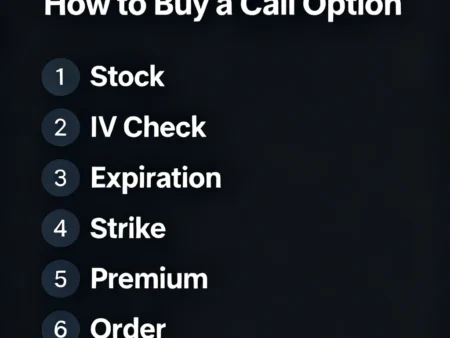
1. Choose a Liquid Stock Large, actively traded stocks have tighter bid-ask spreads and better liquidity. Good starting points: SPY, Apple, Nvidia.
2. Analyze Price Movement Traders look for support and resistance levels, momentum shifts, and upcoming catalysts that might move the stock.
3. Choose an Expiration Beginners often start with 30-60 day contracts. Weekly options decay very quickly and leave little time for a trade to develop — not the best starting point.
4. Select a Strike Price At-the-money strikes provide a balance between cost and probability. For a complete breakdown see our guide on How to Pick the Right Strike Price.
5. Use Limit Orders Options bid-ask spreads can be wide. Always use limit orders — never market orders — to avoid paying more than necessary.
Example Trade Scenario
Assume Nvidia (NVDA) trades at $130.
A trader buys:
- 1 NVDA $135 Call
- Expiration: 30 days
- Premium: $3.00
- Total cost: $300
Scenario 1 — Stock Rises NVDA climbs to $150. The option may be worth roughly $15. $15 × 100 = $1,500 — Profit: $1,200
Scenario 2 — Stock Stays Flat NVDA remains near $130. The contract expires worthless. Loss: $300 (the premium paid)
Scenario 3 — Stock Falls Even if the stock drops sharply, the maximum loss is still the premium paid. Loss: $300
Risks and Common Pitfalls
Several patterns appear repeatedly among new traders.
Oversized trades — large positions increase emotional pressure and accelerate losses when trades go wrong. Keep each position small — no more than 2-5% of your portfolio per trade.
Ignoring Theta decay — short-dated contracts lose value quickly. Every day you hold an option without a significant move, time is working against you. See our guide on What Is Time Decay in Options.
Holding until expiration — most experienced traders close positions early to lock in gains and avoid the dangerous Gamma acceleration of the final days before expiration.
Buying deep out-of-the-money options — cheap OTM options expire worthless the vast majority of the time. Lower cost does not mean lower risk — it often means lower probability.
Final Thoughts
Options trading introduces additional variables that stock investors rarely face — time decay, volatility changes, and liquidity all influence contract prices in ways that aren’t obvious at first. Understanding those variables is what separates traders who consistently profit from those who don’t.
The good news: you don’t need to master everything before placing your first trade. Start with the basics — learn calls and puts, understand how Theta works, pick liquid stocks, and keep position sizes small.
When you’re ready to go further, the best next step is learning how to generate income from options rather than just speculating on direction. See our complete guide on Options for Income — the strategy most income-focused traders build their entire approach around.
New to the site? Start with our How to Get Started With Options Trading page — it maps out the exact path from beginner to consistent income trader.
Frequently Asked Questions
Can I lose more than I invest trading options? Buying options limits your risk to the premium paid — that is your maximum loss. Selling options without protection can involve substantially larger risk depending on the strategy. Most beginner strategies involve buying options, where the maximum loss is always the premium paid.
Do I need margin to trade options? Buying calls or puts typically requires only a basic options approval level — no margin needed. More advanced strategies like selling naked options require margin approval. Most brokers offer Level 1 approval (covered calls) and Level 2 approval (buying calls and puts) with no margin requirement.
When is the best time to trade options? Many traders wait until the market stabilizes after the open. The first 15 minutes often show higher volatility and wider bid-ask spreads. The most liquid trading window is typically between 10:00 AM and 3:30 PM ET.
What is the best options strategy for beginners? The covered call is widely considered the most appropriate starting strategy — you already own the stock, you sell a call against it, and you collect premium income. It’s low-risk, income-generating, and teaches the core mechanics of options selling. See our guide on Best Options Strategy for Beginners.
Which Broker Is Best for Options Beginners?
The broker you use matters more than most beginners expect. Fees, platform tools, and cash yield all affect your results over time. Here are the most beginner-friendly options platforms in 2026:
- Robinhood — $0 per contract, the cleanest mobile interface, and a 3% IRA match with Gold
- Webull — $0 per contract, free Level 2 market data, and the best paper trading environment for practicing before risking real capital
- tastytrade — purpose-built for options traders, with the deepest educational content through tastylive
- Fidelity — $0.65 per contract but best-in-class education, 4.5%+ APY on idle cash, and zero-fee index funds alongside your options trading
Ready for More?
See our full Best Options Brokers 2026 guide and Broker Fee Comparison for a complete breakdown.