
Quick Answer
A put option is a financial contract that gives the buyer the right — but not the obligation — to sell a stock at a specific price (called the strike price) before a certain expiration date.
Traders buy put options when they believe a stock price may fall. If the stock drops below the strike price, the value of the put option typically increases.
Put options are commonly used for:
- Profiting from declining stock prices
- Protecting stock portfolios from market drops
- Managing downside risk in volatile markets
Each options contract usually controls 100 shares of the underlying stock.
Key Takeaways
- A put option gives the right to sell a stock at a specific price
- Traders buy puts when they expect a stock to decline
- One options contract usually represents 100 shares
- The maximum loss for the buyer is the premium paid
- Put options can be used for speculation or portfolio protection
What Is a Put Option in Options Trading?
A put option is one of two core contract types in options trading — the other being a call option. While a call option gives traders the right to buy a stock, a put option gives traders the right to sell a stock at a locked-in price, regardless of where the market moves.
This makes put options one of the most powerful tools available to traders who expect a stock to decline, want to protect an existing investment, or need to manage downside risk during uncertain market conditions.
Understanding how put options work is a foundational step for any options trader. This guide breaks down every component in plain language with real trade examples.
How Put Options Work
A put option contains several key components. Understanding these elements makes it easier to evaluate any potential trade.
Underlying Stock
The stock the option is based on.
Example: Nvidia (NVDA)
Strike Price
The price at which the option holder has the right to sell the stock. If the stock falls below this price, the put option typically increases in value.
Example: Strike price of $400. If NVDA drops below $400, the put gains value.
Expiration Date
Every options contract has an expiration date. After this date, the contract no longer exists. Expiration periods range from a few days to several months. Shorter expirations lose value faster due to time decay — a concept covered below.
Premium
The premium is the price paid to buy the option.
Example: Premium of $4.00. Since each contract controls 100 shares, the total cost is $4.00 × 100 = $400.
This premium is the maximum possible loss for the buyer.
Put Option Example
Here is a complete trade example using real numbers:
- Stock: Tesla (TSLA)
- Current price: $200
- Put strike price: $190
- Expiration: 30 days
- Premium: $3.00 per share ($300 total)
Scenario 1 — Stock Falls
Tesla drops to $170. The trader holds a contract giving them the right to sell shares at $190, even though the market price is $170. That $20 difference creates real value in the put option. Depending on time remaining and implied volatility, the contract could be worth significantly more than the $300 originally paid.
Scenario 2 — Stock Does Not Fall
Tesla stays above $190 through expiration. The put option expires worthless. The trader loses the $300 premium — nothing more.
This capped downside is one of the key advantages of buying put options versus short selling.
Put Option Profit and Break-Even
Put options gain value as the underlying stock declines below the strike price.
Using the Tesla example:
- Strike price: $190
- Premium paid: $3.00
- Break-even price: $190 − $3 = $187
At expiration, the trade becomes profitable once Tesla falls below $187. The further the stock drops, the greater the potential gain.
| Stock Price | Put Option Value | Profit/Loss |
|---|---|---|
| $200 | $0 | −$300 |
| $190 | $0 | −$300 |
| $187 | $3 | $0 (break-even) |
| $180 | $10 | +$700 |
| $170 | $20 | +$1,700 |
Because each contract represents 100 shares, a $10 move in the stock can equal $1,000 in contract value. This leverage is why options attract active traders.
When Traders Use Put Options
Put options serve several practical purposes in trading and investing.
Speculating on Falling Prices
Traders buy put options when they believe a stock is overvalued, showing technical weakness, or facing negative catalysts. Instead of short selling shares — which carries unlimited risk — buying puts limits the downside to the premium paid.
Hedging a Portfolio
Put options are used as insurance against broad market declines. An investor holding $50,000 worth of technology stocks might buy put options on a Nasdaq ETF. If the market drops sharply, gains from the puts offset losses in the portfolio. This is known as a protective hedge.
Managing Downside Risk Around Events
Traders often buy puts before earnings announcements or major economic events. The put limits downside if the news is negative while preserving upside if the stock moves higher.
The Protective Put Strategy
One of the most common beginner strategies involving puts is the protective put. It combines owning a stock with buying a put option on that same stock. The put acts like an insurance policy on the position.
Example:
- Stock owned: Apple (AAPL)
- Purchase price: $180
- Put strike: $170
If Apple falls to $150, the trader can still sell shares at $170 using the put option. The loss is capped at $10 per share plus the cost of the premium, rather than the full $30 decline.
Many long-term investors use protective puts during periods of elevated uncertainty — before earnings, Fed announcements, or major geopolitical events.
How to Buy a Put Option Step by Step
Buying a put option involves a few straightforward steps:
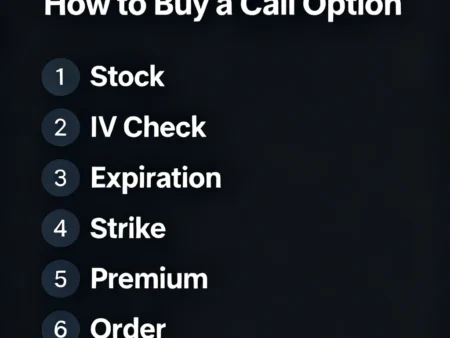
- Open a brokerage account that supports options trading
- Get approved for options trading — most brokers require a brief application
- Find the stock you want to buy puts on using the options chain
- Select your strike price — typically below the current stock price for a standard put
- Choose your expiration date — longer expirations cost more but give the trade more time to work
- Review the premium and calculate your total cost (premium × 100)
- Place the order as a “buy to open” put option
For a full walkthrough of reading options chains and selecting strikes, see: How to Read the Options Chain
Put Options vs Short Selling
Both strategies aim to profit from falling stock prices but work very differently.
| Put Options | Short Selling | |
|---|---|---|
| Max loss | Premium paid | Unlimited |
| Requires margin | No (for buying) | Yes |
| Profit from decline | Yes | Yes |
| Risk if stock rises | Loses premium only | Unlimited losses |
For most beginners, put options are a safer way to express a bearish view than short selling.
Factors That Affect Put Option Prices
Stock Price Movement
Put options increase in value when the underlying stock declines. This relationship is measured by delta.
Time to Expiration — Theta Decay
Options lose value every day as expiration approaches, even if the stock price stays flat. This effect is called theta decay. Buying options with at least 30-45 days until expiration gives trades more room to develop.
Implied Volatility
Higher implied volatility increases option premiums. Buying puts when volatility is already elevated means paying a higher price — and facing the risk that volatility drops even if the stock moves in your favor. This is called IV crush and is one of the most common beginner mistakes.
For more on this, see: What Is IV Crush?
Common Mistakes Beginners Make With Put Options
Buying Options With Too Little Time
Short-dated options lose value rapidly. Many experienced traders avoid contracts with fewer than 21 days until expiration unless they have a specific short-term catalyst in mind.
Ignoring Implied Volatility
Buying puts when implied volatility is at a peak — such as right before an earnings announcement — often leads to losses even when the stock moves in the right direction. Volatility dropping after the event crushes the option’s value.
Risking Too Much on a Single Trade
Options are leveraged instruments. Most experienced traders risk no more than 1-3% of their total portfolio on any single options trade.
Expecting the Stock to Move Immediately
Time decay works against option buyers every day. A stock that moves slowly in the right direction can still result in a losing trade if time decay erodes the premium faster than the stock moves.
Risks of Trading Put Options
- Time decay erodes value daily even if the stock is unchanged
- A drop in implied volatility reduces option prices regardless of stock movement
- If the stock does not fall below the strike price before expiration the option expires worthless
- Options can lose value quickly and are not suitable for traders who cannot monitor positions
Which Broker Should You Use for Put Options?
To trade put options you need a brokerage account that supports options trading. Here are three platforms worth considering:
Webull — Commission-free options trading with a clean mobile interface. Well suited for beginners who want a straightforward platform without high fees.
Tastytrade — Built specifically for options traders. Offers advanced tools, real-time Greeks, and a commission structure designed for active options trading.
Interactive Brokers — Best for traders who want deep liquidity, global market access, and professional-grade tools.
See the full breakdown: Best Brokers for Options Trading
Related Guides
- How Call Options Work
- Covered Call Strategy Explained
- Best Options Strategy for Beginners
- How to Read the Options Chain
- What Is IV Crush?
- Options Trading for Beginners
FAQ
What happens if my put option expires worthless?
If the stock stays above the strike price through expiration, the put option expires with no value. The maximum loss is the premium paid — nothing more.
How much money do I need to buy a put option?
The cost depends on the premium and the stock. Some put options cost under $100 per contract while others on high-priced stocks can cost several hundred or thousands of dollars. The premium multiplied by 100 equals your total cost per contract.
What is the best put option strategy for beginners?
The protective put is the most beginner-friendly strategy because it limits downside on a stock you already own without requiring complex multi-leg setups.
Can you sell a put option before expiration?
Yes. Most traders close positions before expiration by selling the contract back in the market. You do not have to hold until expiration.
Do you need to own the stock to buy a put option?
No. You can buy put options on any optionable stock without owning shares.
Can you lose more than you invest with a put option?
No. The maximum loss for a put buyer is the premium paid for the contract.